The crossing is surprisingly quick. I sit next to Jez and we chat a bit before he goes on deck to be in the fresh air. The Trtl neck support device works impressively well and I manage a few hours’ relatively uninterrupted sleep, with earplugs in and wearing shades to make it feel darker, although my seat is facing away from the window anyway. On waking I drink another coffee and then the announcement comes on the ship’s PA that we are ready to dock.
I join the others in the bowels of the ship, we unstrap the motorbikes and soon enough roll out into the greyness of the Normandy afternoon. There are maybe a dozen bikes plus the van and car. Three participants from Arizona have have joined us: they are American Legion riders who host Bike Tours for the Wounded in Arizona and have done for the past 10 years. One, the famous Papa Ron, is riding a Royal Enfield which Darren sorted him with. The other two are a couple: Karen and Larry. Usually in the US they both ride Indians, but in Normandy Larry is travelling in one of the support vehicles and Karen is riding pillion. For Papa Ron, it’s natural riding on the right. For others, UK based riders, it takes a couple of roundabouts to adjust.
The group makes its way to the village of Ravenoville and a couple of miles beyond to the campsite which will be our home for the week. It’s named after an aquatic bird, the cormorant, and it’s situated on Utah Beach, one of the two beaches on which US troops landed on D Day.
Later in the week we learn why the beaches were codenamed what they were. Each of the three invading armies chose their own codenames. The “American” beaches, Omaha and Utah, were so named after the deeply inland locations in the US, very far away from Normandy, so that if messages were intercepted by Germans, they wouldn’t guess that they referred to Normandy. The specific names were chosen by a US general who asked a few junior officers where they came from and selected the two places which appeared the least Normandy-like. The two “British” beaches, Gold and Sword, were named after fish. And the “Canadian” beach was codenamed Juno after an officer’s wife.
We arrive at the campsite and of course the condition of being part of the advance parry is setting up camp. We unpack the large van: tents, gazebos, a field kitchen (fridge, cookers, utensils), collapsible tables. It’s a serious rig. A few of the group are very tired, having ridden to Poole through the night. Two, including Ron, have very cold hands. Thankfully I’m carrying hand warmers in my panniers, so I share two with them.
The winds are at gale force. We attempt to put up the big communal tent where the kitchen and the mess hall will be. It’s a nigh on impossible task, the wind is bending the scaffolding poles, tearing the roof canvas off and generally making it very difficult. Panel by panel we get the structure up, and everyone is exhausted. The next task is to put up the tents. Several people, more senior, older, or with disabilities, are allocated a 4 person tent to themselves. Some couples share 5 person tents. Groups of four get 8 person tents, with 4 compartments. Getting the tents up in the screaming, howling wind is also very hard. Poles bend and fracture, bits of fabric tear or fly off. Eventually we get enough tents up for the group already there and a couple more.
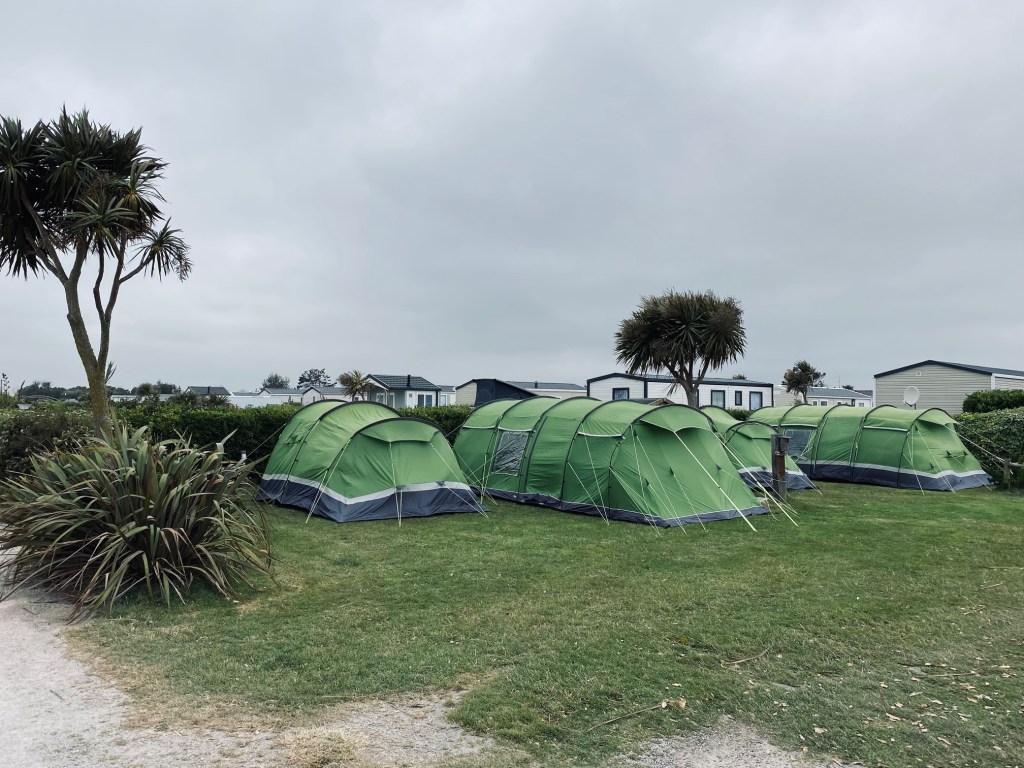
The campsite has shower blocks, a swimming pool, a laundry room, a small and expensive convenience store, and a bar. I unpack the bike and populate the pod I’m allocated. I was planning to have a swim, but it’s too late, so I take a shower in the shower block and attempt to sleep. The tent is thrashing around my head, flapping and slapping violently. The wind is howling and the surf, some 50 metres away on Utah Beach, is roaring furiously. Even with earplugs in and a scarf wrapped around my head, sleep seems virtually impossible and I hit the first of several low points, but several hours in it appears I eventually drift off.
I shudder awake the next morning and hear activity around me. Some folks are already up, further unpacking, drinking coffee from the big urn in the mess hall, chatting. Some are snoring, still asleep and exhausted from the previous day. I remove my pyjama bottoms and base layer leggings I have on to keep warm in the bitterly cold Normandy night, pull on my jeans, slip on my “barefoot” Xero shoes huaraches (essentially a foot shaped 4mm thick piece of rubber tyre and a length of paracord to loop around the big toe and the heel) and tentatively crawl out of the tent. I make my way to the communal area to find Amy, Darren and Abbie busy in the kitchen. Obviously I’d forgotten to bring my crockery, mug and cutlery from the tent, so I grudgingly make another trip to get them. I have a double walled aluminium coffee mug, a stainless steel bowl and one of those clip-together folding camping cutlery sets which splits off into a fork and a spoon. It appears I’m the only one in the group who made a prior request for a plant based diet. I think bacon or sausages must be cooking, but I opt for a baguette with jam and an apple, which is sufficient to keep me going. After the second mug of coffee I’m beginning to recover, a bit. My forearms and shoulders hurt from fighting with the tents in the wind the previous day. The wind is no calmer, the communal tent is shuddering and the material of the wall panels is bulging heavily.
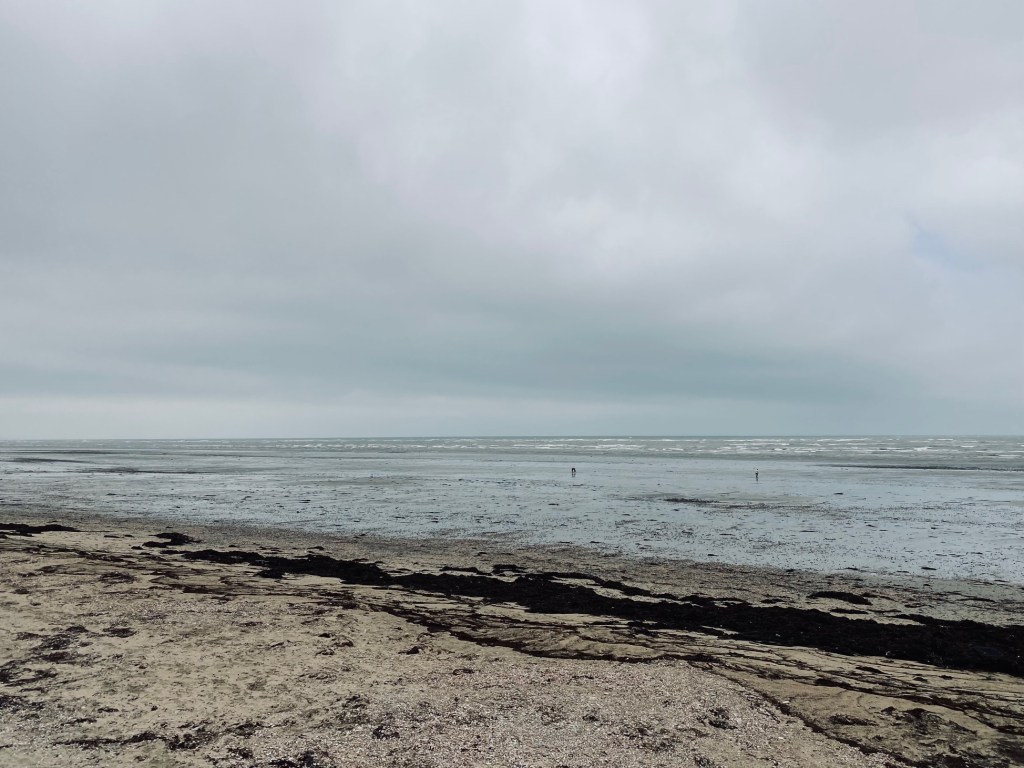
After breakfast, I go to explore Utah beach. I walk leaning into the wind which is forcing me backwards. It nearly rips the wraparound sunglasses from my face and I remove them, gripping them tight in my hand instead. Sand and sea lash my face, some of this stinging mixture gets in my eyes. Despite it being June, and the temperature being above zero, it’s bleak and inhospitable as hell. For a moment the howling of the wind and the crashing of the surf transforms into the barrage of artillery fire and the screams of wounded and dying men. How might it have been, for the American soldiers landing here making their way forward millimetre by millimetre under the barrage of frantic defence fire imparted by desperate Wehrmacht defenders who surely must have already known that their fate was sealed?
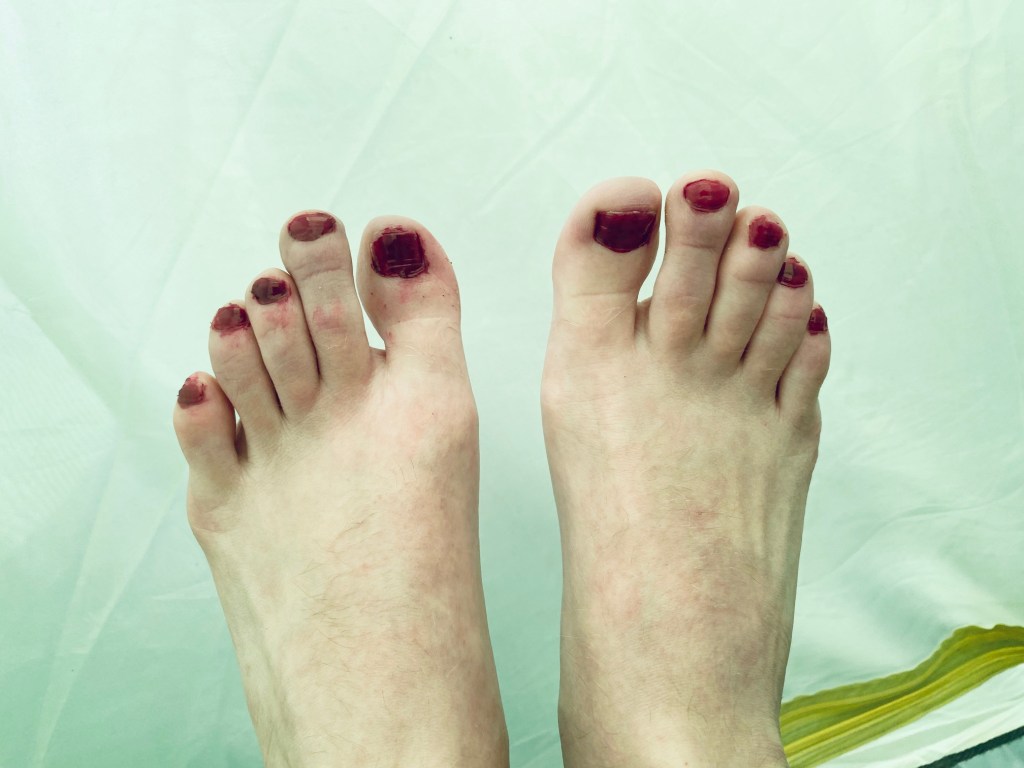
I stagger back to camp, the wind now at my back and throwing me towards it. Back in the tent, I sink back onto my slightly deflated airbed, and close my eyes. The beach visit did not portent well for the rest of the week. I try to arrange my stuff in some logical manner and take the opportunity to apply dark purple nail polish to my toes, to protect them from the many hours and thousands of miles in hard motorcycle boots. Aesthetically speaking I do a terrible job, but from a functional perspective of keeping my toes safer it’ll do.
Several of the tour leaders leave and return a few hours later with another group, some riding, others in the support vehicles. Almost everyone is here now, beneficiaries who are both passengers and riders, volunteer riders and a couple of riders who are here for the tour without necessarily transporting a veteran pillion. Folks find their tents and settle in.
At dinner there is a briefing. I meet the guy whose transport I’ll supply for the week. His name is Paul, he has several military tours behind him prior to his medical dischage. He has significant physical and mental wounds, walking with a cane. He has recovered from significant addiction and has been completely sober for som etime. His physical recovery has included kayaking, water polo and other sports, and he has competed in the Vetewran Games in Israel. We’re about the same age and a cliche though it may be, we hit it off instantly. As we ride together and talk through the week, we discover that we have much in common, but our initial immediate connection comes via our shared love of Iron Maiden. As we talk, I can sense that this is a lifelong friendship in the making, and a while later I think Amy and Darren for pairing us. Amy grins and tells me that she has a “special talent” for knowing who will get along, although “get along” is something of an understatement.
During the evening briefing we also meet Andy who who will be leading the tour. Andy is a serving Army medic, close to retirement. He’s also an advanced rider and a history buff and it becomes apparent that he knows all there is to know about D Day and related historical events. We are in safe hands.
The day reaches its conclusion. Some of the group head to the bar, others, for various reasons including recovery from alcohol addiction, head to the tents. I spend a bit of time in the communal tent writing, and then head to the shower block to brush my teeth and prepare for bed. It’s still light when I get into my pod, but I put earplugs in, wrap the keffiyeh around my eyes to block the light out and do my best to get to sleep. The wind is brutal and unrelenting and the tent is twisting, flapping, groaning, and bulging as the previous night. I do my best to sleep, and succeed partially.
The next morning comes. Fresh baguette for breakfast, delivered from a local bakery at 7.30am is welcome. A shower in the shower block, motorbike gear on, and the pillions and riders assemble near the front of the campsite.
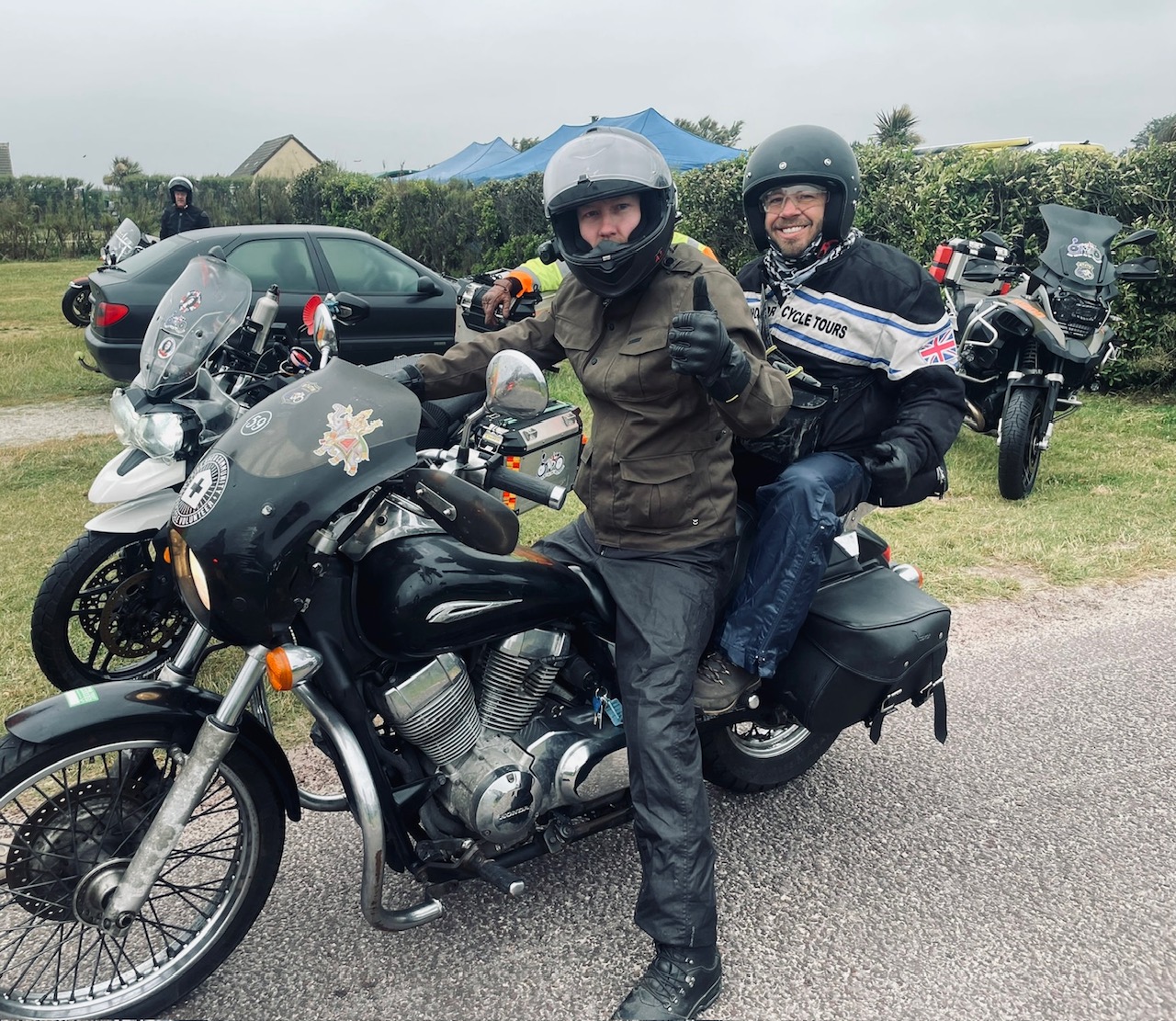
Paul and I discuss how we’ll take the week. He is an experienced pillion, having ridden in the US with Bike Tours for the Wounded the previous summer. We decide we’ll try the pillion without the Airhawk cushion first and see how we go. Paul has a backpack which we strap to the luggage rack with bungee cords, and his cane folds, so goes in one of the panniers. Veronica is one of the lowest cruisers out there, and so for someone with Paul’s mobility needs getting onto the pillion seat is less of a challenge. Nonetheless, the first time he does this, he requires assistance from one of the organisers. Paul’s experience as a pillion shows: he taps my shoulders when he’s about to get on, taps me again when he’s settled, and communicates perfectly.
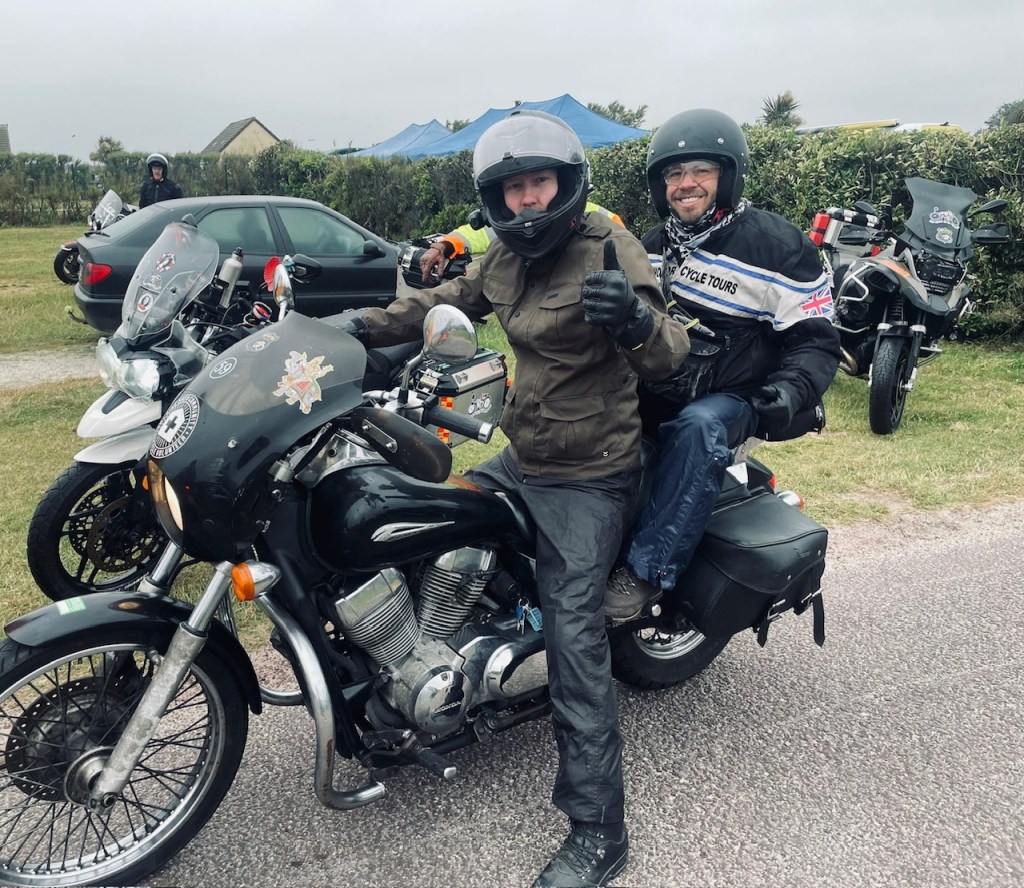
Amy photographs the individual bikes and their occupants. As she approaches us to take a picture, Darren bellows “Smile you miserable fucker!!” I’m not sure which one of us that’s aimed at, but we both grin, and after the impromptu photoshoot, roll out towards Omaha Beach.


One thought on “Normandy Landing”