My first long distance motorcycle ride in 2018 was epic by my own standards, but not at all so by the standards of someone like Ted Simon. It was certainly much less epic by the standards of Nick Sanders who had circumnavigated the world on a motorcycle nine times, on one occasion doing so on a Yamaha R1 (a 1000cc sportsbike) in nineteen days. Still, for me the post journey funk lasted a number of months, just as Ted had warned. The ennui was interrupted now and then by some event or other, including the Alexandra Palace Motorcycle Show where I met Nick in person for the first time.
Much has been written about sliding doors moments, events which although may seem small at the time, have the effect of the proverbial butterfly flapping its wings on one side of the world and setting in motion a series of occurrences which eventually result in someone dropping a cup or sneezing on a different continent. Or something like that.
It happened to me before, when I sat down next to Ted Simon in August 2018 and asked him what I should. Two weeks later I was in a rather short queue for the ferry in Harwich, waiting to sail east and cover 5,000 km or so in a loop around Europe, rolling through its traumatic past, fractious present, and anxious future, sleeping on friend’s floors and in roadside guest houses, and trying to capture not only intellectually but emotionally the “European Idea”.
This time, it seems, there would be a much longer lead up, but meeting Nick Sanders and taking his beautiful book in my hands was that event.
I read the book in one breath, and found it to be a profound treatise on solitude which spoke to my own recent experiences. I wrote and published on my blog a very positive review, and alerted Nick that I’d done so. Nick seemed to like it and invited me to another, larger, motorcycle show where he was appearing as his guest. I gladly accepted his hospitality and went along. After spending a bit of time with Nick, I went around the halls looking at the various exhibitors’ stands: new motorbikes, clothing, paraphernalia, and so on. To one side were a few touring companies, charities and activist groups. One of them, Bike Tours for Wounded, caught my eye, and I suppose that is where our story begins for real.
The Bike Tours for the Wounded logo, a schematic image of a wheelchair user and a motorbike, was what I first noticed. I went to the stand and spoke with Darren, the founder of the organisation. The premise he described to me was simple and brilliant: BT4TW run motorcycle tours for injured, disabled or sick veterans who want to experience the joy of such a tour but for whatever reason cannot operate a motorbike. The motorbike instead is ridden by a volunteer rider who also subsidises the costs of the beneficiary. The tours, he told me, were often transformational experiences for the beneficiaries and the volunteer riders alike. Their main arena of activity is the US with very long rides across the North American continent. But they also were offering a smaller tour of Normandy and the sites and landmarks connected with the D Day landings which signalled the opening of the second front against Hitler by the Allies in 1994. This seemed much less intimidating, and having consulted with my wife, I signed up and paid for the cost of the tour for myself and as yet of an unknown beneficiary veteran.
In preparation I asked Darren what kinds of injuries and disabilities the veteran beneficiaries had, in order to better prepare the bike to be as comfortable as possible. “Don’t worry” he said, “It’s mostly mental wounds… although we’ve had a triple amputee before”. I figured the most sensible thing to do was to instal a set of new shocks and ordered a pair of Hagon ones. I appreciated the new more robust suspension straight away and had a pleasant Christmas with a couple of rideouts. New Year’s Eve was a nice, quiet affair. Sometimes I’d think about the forthcoming trip to Normandy in June 2020, and enjoy the thought that I’d be helping someone.
In January 2020 news of a new disease began to circulate. By late January based on my own experiences of working to fight the TB pandemic in prisons some two decades earlier, I was doing what I could to raise alarm about what covid might do in overcrowded unhygienic prison environments. I was the first in the world to express concern about this publicly and my voice was a solitary one. Policy makers were concerned with other things and some justice reform organisations which I’d previously regarded as allies ignored me, as the cause at that moment was at the unfashionable end of a permanently unfashionable topic which was prison health.
By late February it became clear to me that the virus was behaving like other infectious diseases in the prison setting: attacking immunocompromised people living in unhealthy conditions. Data from Italy and Iran told me that this was a fast moving merciless pandemic which would exacerbate health inequalities. I got to work and produced a set of tools for justice systems so they could implement emergency protocols at different stages of the justice process to ensure that prisons did not become an incubator of covid, amplify it and pass it back to society tenfold, as they had done with tuberculosis. By 6 March the tool was making its way around justice administrations wherever I had contacts and translations in five languages were under way. Authorities in many places still appeared oblivious, but by the time we eventually went into lockdown in late March, my tool was already in use in several jurisdictions. Some organisations began to address the pandemic more and more seriously. Sadly some others regarded it as a vanity exercise, to the detriment of those who relied on their services. Of particular concern were some local leaders who continued to deny the seriousness of the public health impact well into March, and in particular did little or nothing to protect transport workers and their passengers.
In the absence of suitable medical research early in the pandemic lockdowns eventually became the main non pharmaceutical intervention for protecting public health, and the one in Britain came in late March. Messages began to come in about events and other plans being cancelled for the summer. The Normandy trip was one. I resolved myself to this.
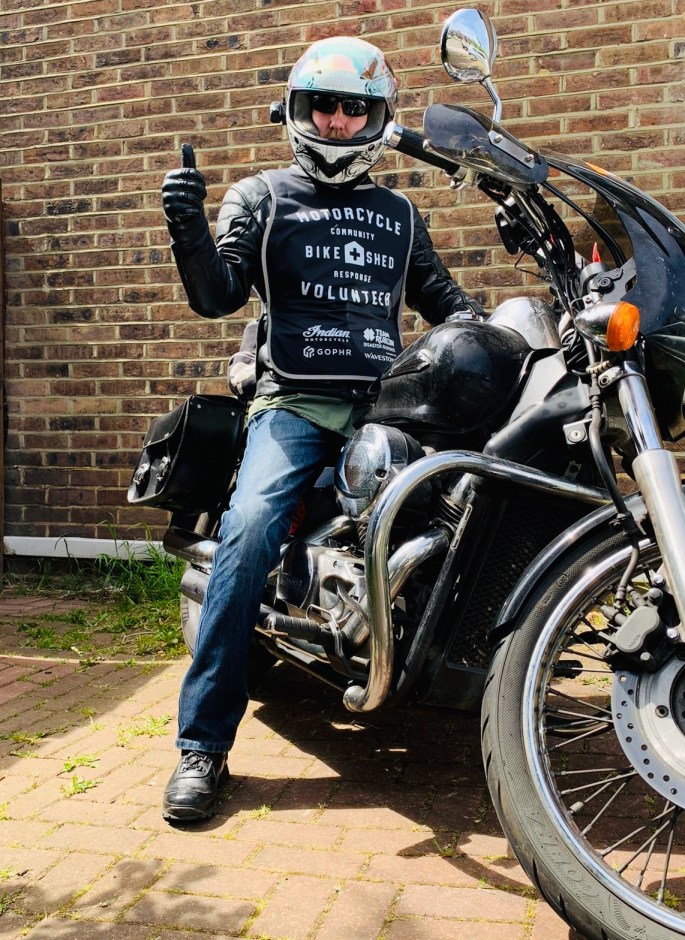
In the meantime, along with a few thousand other bikers, I became a motorcycle community response volunteer. We did what we could to support the NHS and prop up the collapsed medical supply chain, alongside many other volunteers. We delivered diagnostic equipment to suffocating patients, hot food and prescription medication to isolating vulnerable people, and PPE to everyone from GP surgeries to care workers. The PPE was sewn by garment workers from donated curtains and bedsheets, or 3D printed by employees of tech startups.
The bikers’ contribution in London was organised by the Bike Shed (whose founders were later decorated for doing this), usually a members’ club in Shoreditch for aficionados of vintage and custom motorbikes. Several Bike Shed team members acted as dispatchers, taking calls from GPs and hospitals and dispatching volunteer riders like me to patients and medical facilities in need using a courier app called Gophr. The medical aspects of the operation were overseen by Covid Crisis Rescue, an organisation set up by Dr Sharon Raymond. Re:ACT Response provided some logistical support too. Our common enemy was the virus.
The pandemic brought out the best in many. Unfortunately for patients and communities, in some it also brought out the worst. The virus found willing allies among some local government officials. Bowing to pressure form small but influential and well funded lobby groups, they closed vital roads, installed various on-surface hazards deadly to motorcyclists, and supported some local councils in London to introduce so called “Low traffic Neighbourhoods”: in reality traffic relocation schemes which jammed up the roads with previously unheard of volumes of traffic and prevented access by community members and volunteers to residential streets by vehicle. Being unable to access certain streets, especially in less affluent areas where lower quality overcrowded housing contributed to more people falling ill, was from our perspective unforgivable. We were fighting the virus and doing what we could to prolong and save lives, and here were local government officials creating physical barriers which prevented help reaching those most in need.
We did what we could to save as many people as possible under the circumstances. Some of us saw dying and dead patients. The pandemic showed no sign of abating. I spent Christmas Day 2020 on call, and had several callouts through the day, including to a very sick younger woman, on her own with a child. January 2021 was the worst point we had, with me (by far not the most active volunteer) attending twelve suffocating patients in a single evening.
By spring it became clear that the rescheduled Normandy trip would not go ahead that year. I rebooked the ferry, at what felt like was an unreasonable fee for the alteration. In better news, thanks to the vaccine programme, the pandemic began to ease off, but by early 2022 there was still much uncertainty and Darren called me again to let me know that the trip was postponed to 2023. I rebooked the ferry again, and paid another fee for changing the sailing.
In the meantime Bike Tours for the Wounded ran several tours of the USA, and being in the WhatsApp group with the beneficiaries and volunteer riders gave me a point of reference. Pictures of the tours in the US also looked wonderful: lots of smiling people in stunning settings. So when 2023 came around, and I got confirmation that the Normandy trip was going ahead. There was no turning back.
 Blac Ridere