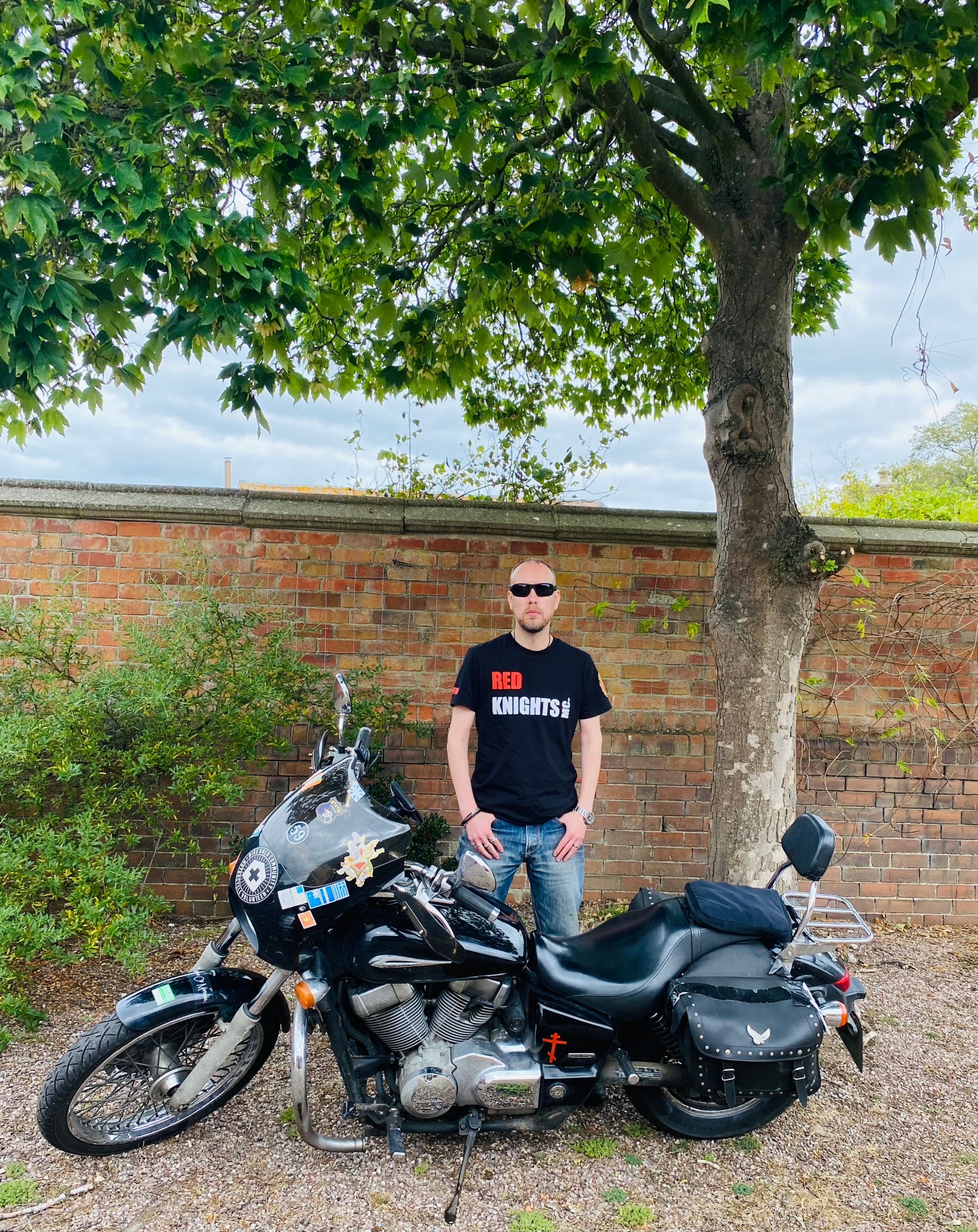
If you, like me, appreciate the work of Stephen R Covey, you at least occasionally “seek first to understand”. Some of you have been reading this blog since 2018, so you know that that is how I try to approach motorcycle touring: to move not only through space, but also through ideas, history, and occasionally philosophy, within my own limited capacity for understanding such complex concepts. I measure distances not only in miles, but also in meaning.
You may also know that I am a fan of classical theatre and you have no doubt noticed the occasional Shakespeare reference on these pages. So it won’t surprise you to learn that for a number of years I’ve been supporting British Touring Shakespeare during their summer tours of the UK, assisting with communications, relationships, and some other aspects of productions. The wonderful thing has been the ability to ride to some very beautiful locations around Britain where BTS has staged performances of plays like A Midsummer Night’s Dream, Twelfth Night, the Two Gentlemen of Verona and so on. The locations vary from purpose built woodland theatres to nature reserves, and of course include historically significant manor houses, many of which date back to the time of Shakespeare himself.
One such place is Soulton Hall near Wem in Shropshire. British Touring Shakespeare was the first theatre company in Britain to stage socially distanced open air classical theatre performances during the recovery from the pandemic, and Soulton Hall was one of the first venues to host such a performance, of The Two Gentlemen of Verona, during that strange and difficult time.
The present hall was built in the mid-16th century by Sir Rowland Hill. I think Sir Rowland was a wealthy London merchant, the first Protestant Lord Mayor, MP, and a patron of the Geneva Bible. Do fact check me. His new hall embodied Renaissance ideals of order, symmetry, and learning. It has been looked after by the Deakin and then the Ashton family (transitioning through marriage) for several hundred years.
This year’s British Touring Shakespeare UK tour of A Midsummer Night’s Dream and a new adaptation of Frankenstein has taken the company to some interesting locations, among them Penshurst Place in Kent, and Fyne Court in Somerset. Fyne Court was home to the scientist who was said to have inspired Mary Shelley herself with his experiments with electricity. But it was Soulton Hall that I most looked forward to visiting, and I’ll tell you why in a little while.
The ride to Shropshire from where I am in East Anglia is a couple of hundred miles. Not too far, but not exactly a short hop either. The night before I stay with my friend Mary in Buckinghamshire. She is the production manager with British Touring Shakespeare and has kindly agreed to accompany me on the ride to Soulton Hall.
In the morning, after a coffee and a work call, we strap Mary’s hard case to the luggage rack with a few bungee ropes. My own fairly minimal kit is in a tank bag. We roll out, with Bowie’s “Rebel Rebel” as our opening musical number on my Tribit bluetooth speakers which are strapped to the handlebars. It’s a nice day so I decide to avoid motorways and take the scenic route. I am always a cautious rider, and when I carry a pillion I am particularly conscious of torque and other physical forces. Mary is the perfect pillion: light, intuitive and leaning with me and the bike in all situations.
The ride takes us along Watling Street: an ancient thoroughfare which in its entirety runs from Dover in Kent to Wroxeter in Shropshire, via London and St Albans. The contemporary name originates from the Old English ‘Wæcelinga Stræt’, dating to a period when the word “street” (from Latin via strata) simply meant any paved road, without implying an urban setting. The Waeclingas, meaning “people of Waecla”, were a tribe or clan located in the St Albans area during the early medieval era. The Anglo-Saxon name for St Albans was Wætlingaceaster, recorded in a charter from 1005, which would correspond to Watlingchester in modern English.
I am fascinated by ancient infrastructure and so I am happy to have the opportunity to ride along this road, and as I so often do, I derive a certain satisfaction from the thought that I am one of many millions of travellers to pass these places, and that maybe a thousand years ago another rider, perhaps on a horse, was making a similar journey to me, for similar reasons.
We need to break up the journey, and as any motorcyclist worth their salt will know, right in the middle or our route lies Hinckley. TRIUMPH! I have never been, and this seems like the perfect opportunity. We decide to stop for lunch at their famous and very well reviewed 1902 Cafe, as the detour is minimal.
I needn’t retell the history of Triumph for my readers, so here is a very short summary to refresh your memory, which you may feel free to skip. Triumph Motorcycles is one of Britain’s most iconic motorcycle manufacturers. It traces its origins to 1902, when German-born Siegfried Bettmann began producing so called “motor-bicycles” in Coventry. The company rose to prominence in the interwar and post-WWII years with models like the Speed Twin and the Bonneville, and came to symbolize British engineering and style worldwide. In ‘The Wild One’ Marlon Brando’s character rides a Triumph. Despite setbacks, including the destruction of its Coventry works during the Blitz and a turbulent period of decline in the 1970s, the brand was revived in the 1980s and relocated to Hinckley, just off the historic Watling Street, where we happen to be passing. From this modern base, Triumph has re-established itself as a global manufacturer, blending its heritage with contemporary design and technology.
The weather is kind and no rain is forecast. But as we approach Hinckley, suddenly and without warning the skies open. What’s more, there are roadworks on the direct approach to the Triumph facility, and it’s not possible to filter. We sit in stationary traffic for a couple of minutes getting drenched. The moment we get moving the rain begins to recede. Presently we pull into the huge Triumph compound and park in front of the building.
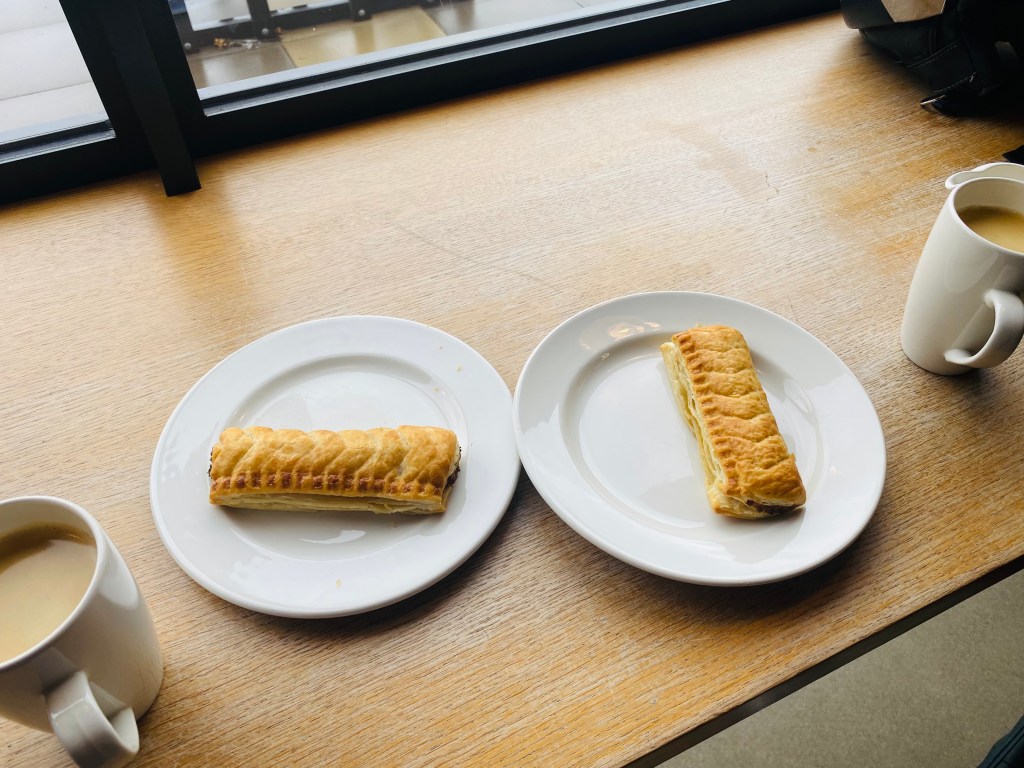
Inside, the 1902 Cafe is pleasant and modern. Apparently it also functions as a free workspace if you work on a laptop, you just need to prebook a space. What a great idea, if I lived nearby I’d use it all the time. We order coffee and vegan sausage rolls and decompress a bit as we dry off. Mary stays at the cafe while I take a look around the museum.

The exhibit presents the history of Triumph through the ages, with a focus on their many sporting achievements – trophy winning bikes from across the decades, ridden by bonafide track and TT legends.
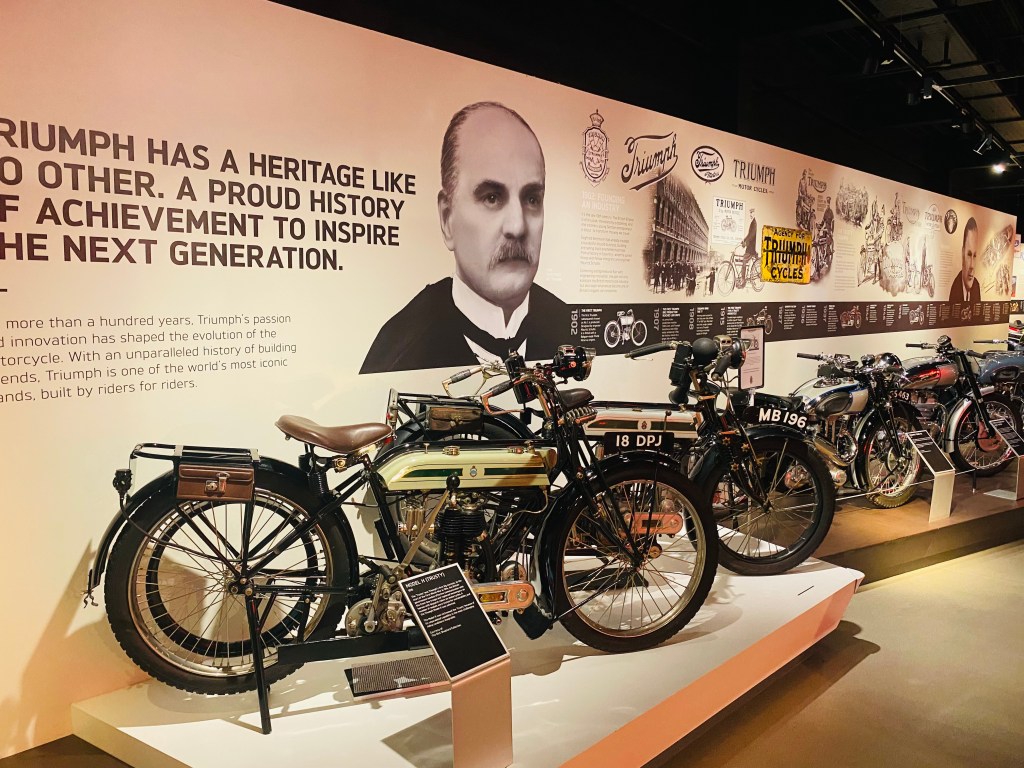
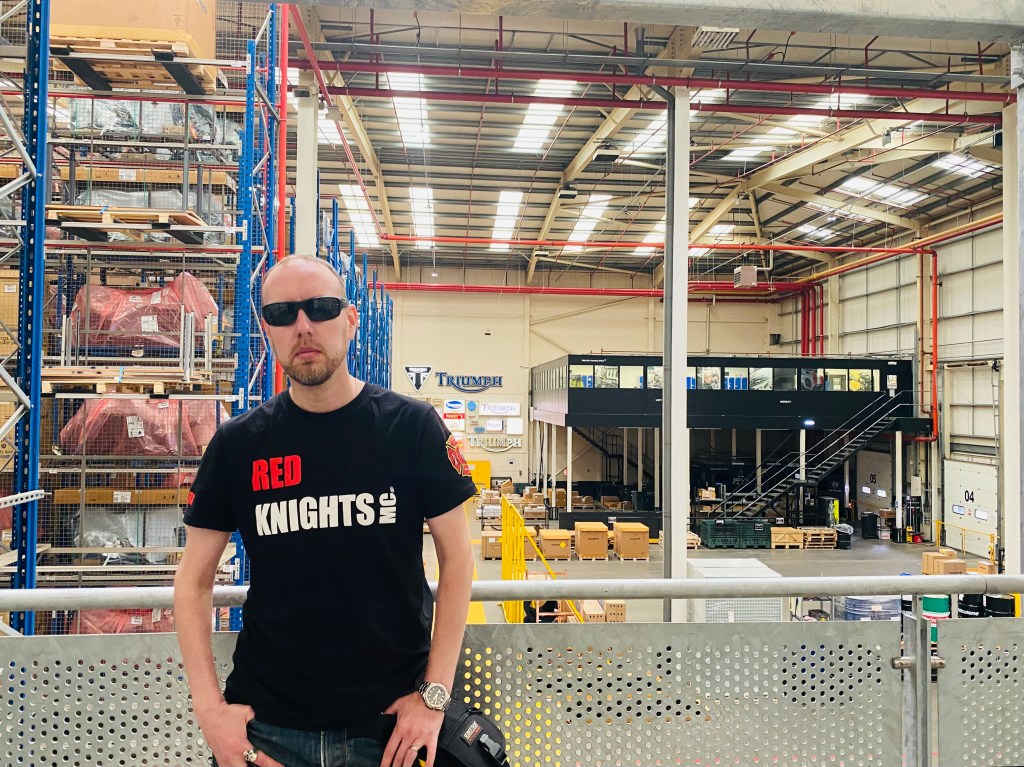
The adventure side is less well represented, for example Ted Simon’s legendary round the world bike is displayed elsewhere. The exhibition is on two floors, and one must ascend a set of stairs between them. To my astonishment, the staircase is literally in the factory, and one can overlook the pristine facility from the mezzanine.
I return to the cafe, we finish our coffees and get on our way. The first petrol station I planned to stop at is shut so we continue for another twenty miles until an alternative one appears. I fill up, we get back on the bike and then I realise that something is missing. Idiot! I’d left the tank bag at Triumph! I ring them, and the very friendly person at the other end of the phone says “We’ve got it right here!” So I apologise to Mary, and we absolutely gun twenty miles in the opposite direction. I’m not proud to say that during some moments I’m riding “like a Londoner” (I am one after all and old habits die hard or don’t die at all). I maintain safety, keep to the speed limit and of course as always observe the Highway Code in its entirety but it’s not exactly a Zen ride.
We return to Triumph, and a very very nice man hands me the tank bag. I am reunited with my toothbrush, spare pants and socks, and phone charger. I apologise to him, and again to Mary, and we set off once more in the direction of Soulton Hall. My absent mindedness has added an extra forty miles to our ride.
The rest of the ride is uneventful. We reach the Shropshire border and roll through the beautiful countryside until the iconic and instantly recognisable shape of Soulton Hall appears on our left. I bounce Veronica into the gate across the generously spaced (to put it politely) cattle grid and we are greeted by Tim of the Ashton family who have been custodians of the hall for many generations.
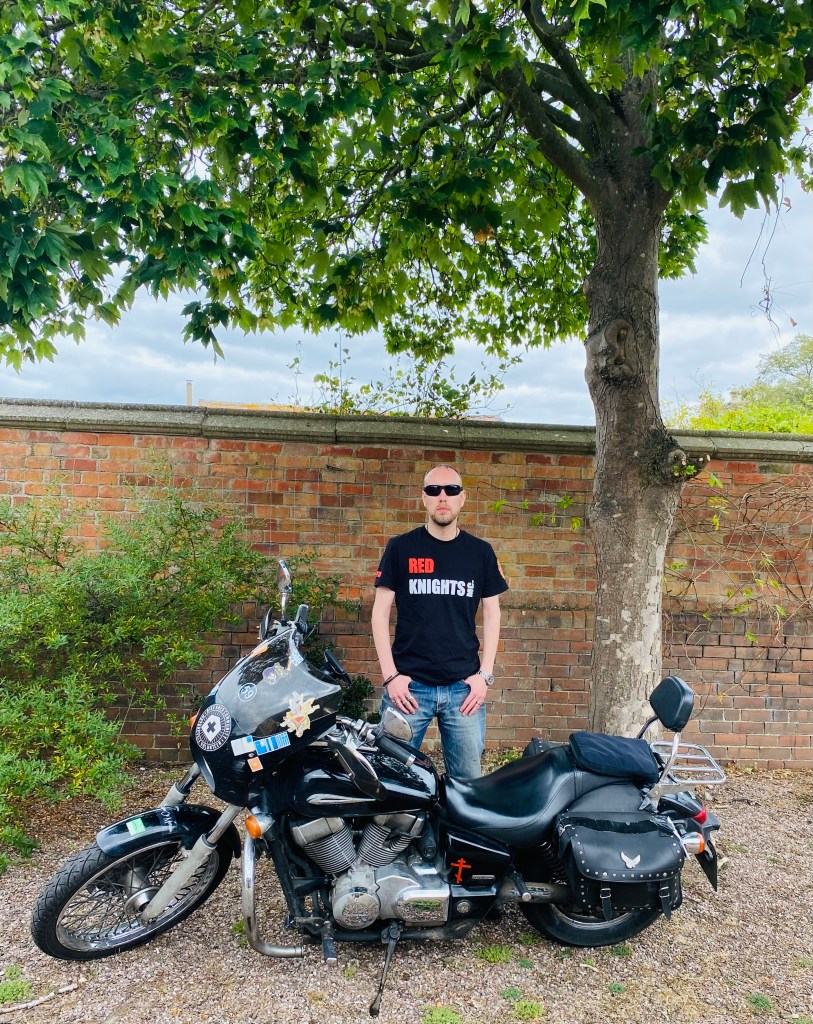
The next day the rest of the cast arrive and we stage the first theatrical performance for several hundred years at the hall’s Epidaurus Court, a purpose built performance space which fits with the building’s geometry both in the mathematical and the spiritual sense. Soulton Hall’s architecture carries much meaning, and its logo recalls the choreography of an ancient dance which has geometric significance tracing its origins from Plato’s ideas through to Christian philosophy. Light travels through the building in ways which evoke crosses on significant dates, and the faces of the building contain certain intentional symmetries and asymmetries. The rhombic dodecahedron shape recurs, time and again.
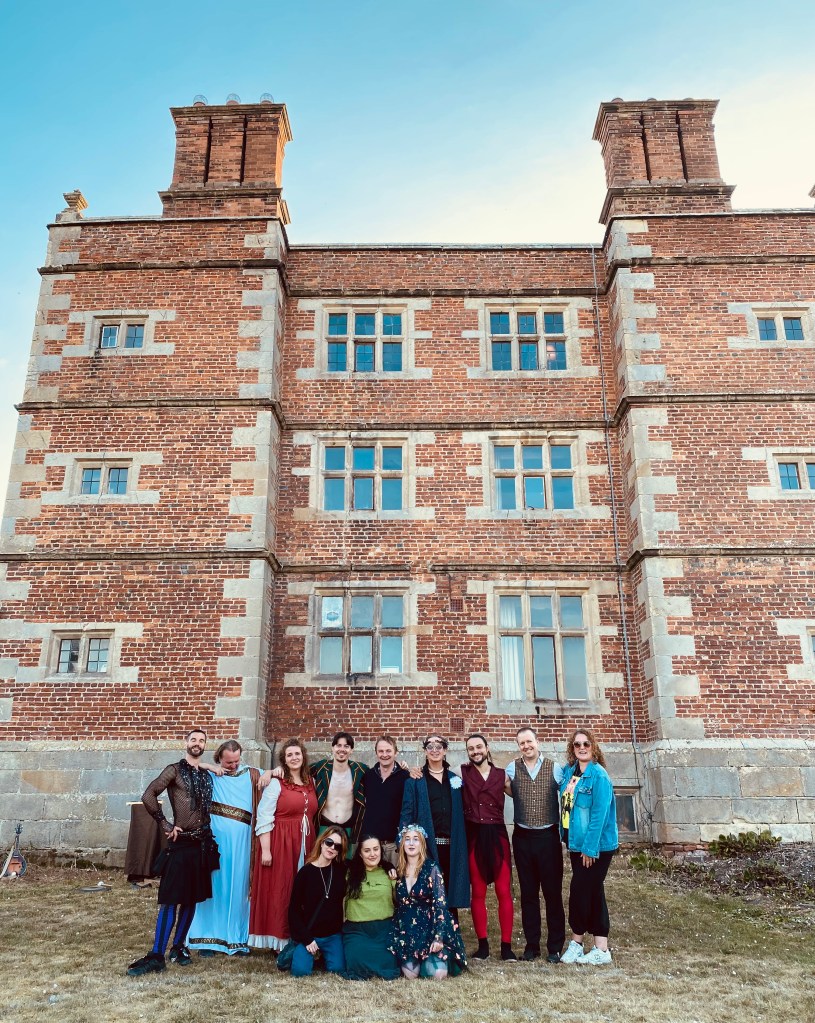
The location was an inspiration for Shakespeare’s As You Like it: the Forest of Arden was nearby, the hall’s builder Sir Rowland Hill (cousin of Shakespeare’s mother Mary Arden) is almost certainly the prototype for Old Sir Roland; Soulton Hall was the family home of Thomas Lodge Jr., whose novel ‘Rosalynde’ served as the source for Shakespeare’s play, lending the name to one its lead characters. The Shakespeare connection runs deep.
British Touring Shakespeare performs A Midsummer Night’s Dream. The performance space is at capacity, the cast brings it, the audience, young and old, are delighted. The performance culminates with a dance performed by the cast, choreographed by British Touring Shakespeare’s Lucyelle Cliffe, West End star, dancer, choreographer, and deep spiritual thinker. The dance is a very strong nod to the one in As You like which itself is recorded in Soulton Hall’s annals and immortalised in its logo and its dancing pavement mosaic. Historical, spiritual and geometric continuity is present, and the magic of theatre ensures a kind of oneness between the cast, the audience, the hosts, and those of us who had a hand in enabling it.
I try to understand. I don’t necessarily succeed, but I try. Covey’s work (you remember him from the start of this blog post?) is kind and wide open, and his guidance is inclusive. And yet, his Christian outlook is very present, he frequently references the importance of his own and his family’s participation in church life as a social activity and one of community value. I lean back in my camping chair and observe the scene around and in front of me, against the backdrop of the magnificent building with both its hidden and obvious meanings.
Seek first to understand.
Later, after the crowds depart, there is a private BBQ with dear friends, some of whom made the journey specially, and with some others who are welcome. Intense conversations follow an intense day. The long ride was worthwhile, so many times over.
The ride back, solo this time, is uneventful. I chug my way through two hundred miles in a few of hours, with one petrol break. When I ride solo, I think; as my readers know. And this time, more than ever, I am seeking to understand.
The opportunity to continue understanding presents itself a few weeks later. There is an exhibition in Colchester at the Minories, called Number in Space and Time. For a long distance rider like me, the run along the A12 is not a challenge. That is, until about 25 miles in, when things grind to a halt due to an accident. I filter as much as I can, and get through it, eventually reaching Colchester nearly an hour later than planned. I park on the High Street next to the delivery riders, ask one of them to keep an eye on Veronica, and make my way to The Minories.
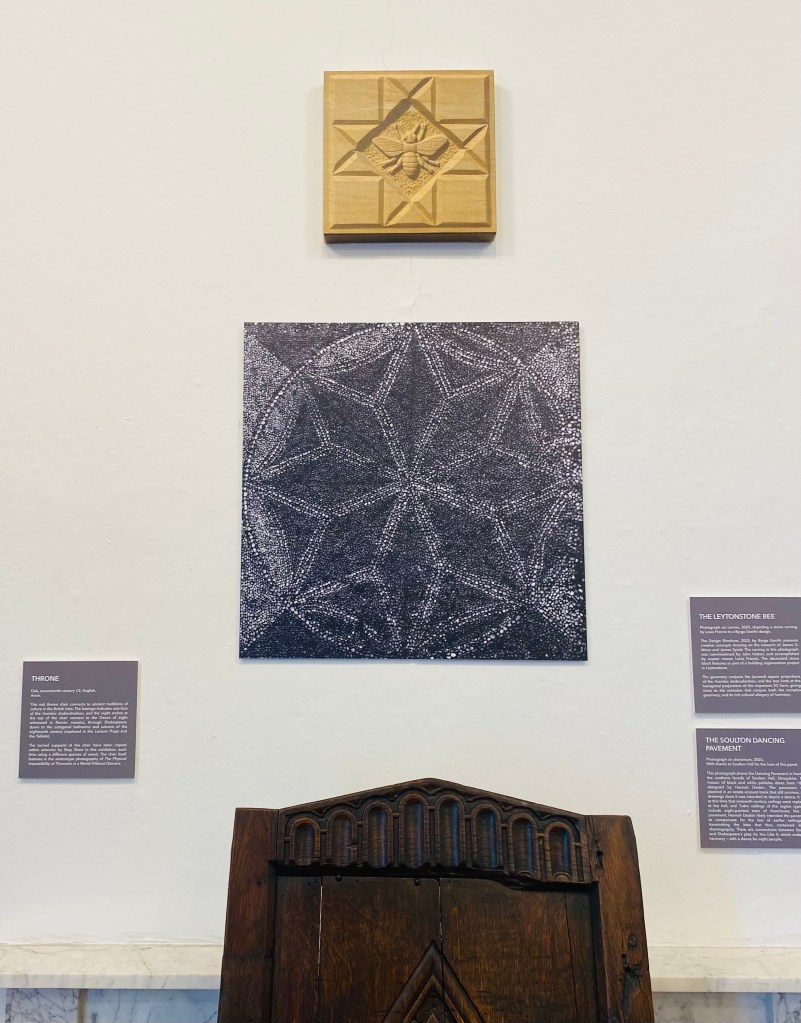
The exhibition presents five years of research by James D. Wenn and James Syrett of Byrga Geniht Ltd., exploring the overlooked role of the rhombic dodecahedron in art, mathematics, theology and cultural history. Through commissioned works by artists including Jacob Chandler, Shay Shani, Caroline Weidman, Dave Shrimpton, and Teresa Clay, the show bridges ancient geometry with contemporary expression, and hints at how these patterns may underpin heirloom design and modern creativity. Anchored in Soulton Hall’s heritage, it leverages the work of figures such as Hannah Deakin, a very early 19th-century pioneer of higher-dimensional geometry whose insights were long ignored, and Sir Rowland himself. In weaving together themes of lost and rediscovered genius, Renaissance humanism, and living tradition, the exhibition is both a celebration of cultural continuity and a call to a “new renaissance” where art, mathematics, spirituality, and history can once again inform everyday life.
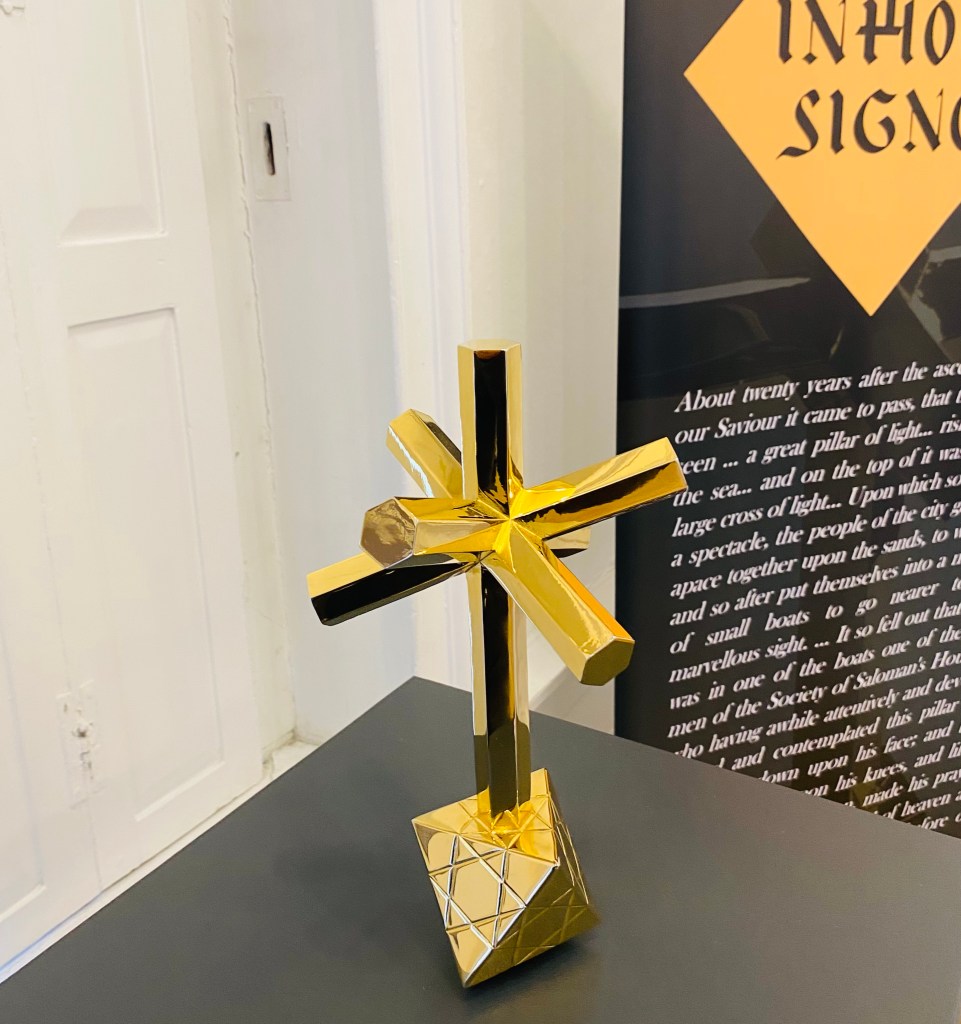
I look around, take a few pictures for future reference, and take in as much as I can. Connections are made. First Shropshire, then Colchester. Shakespeare, Plato. Honda, Triumph. We’ve been here before, we just need to remember.
The ride home feels shorter than it should. I’m riding solo, gliding along the A12, and I think, and try to see the connections.
One sees the world differently from a motorbike.
Seek first to understand.
 Blac Ridere