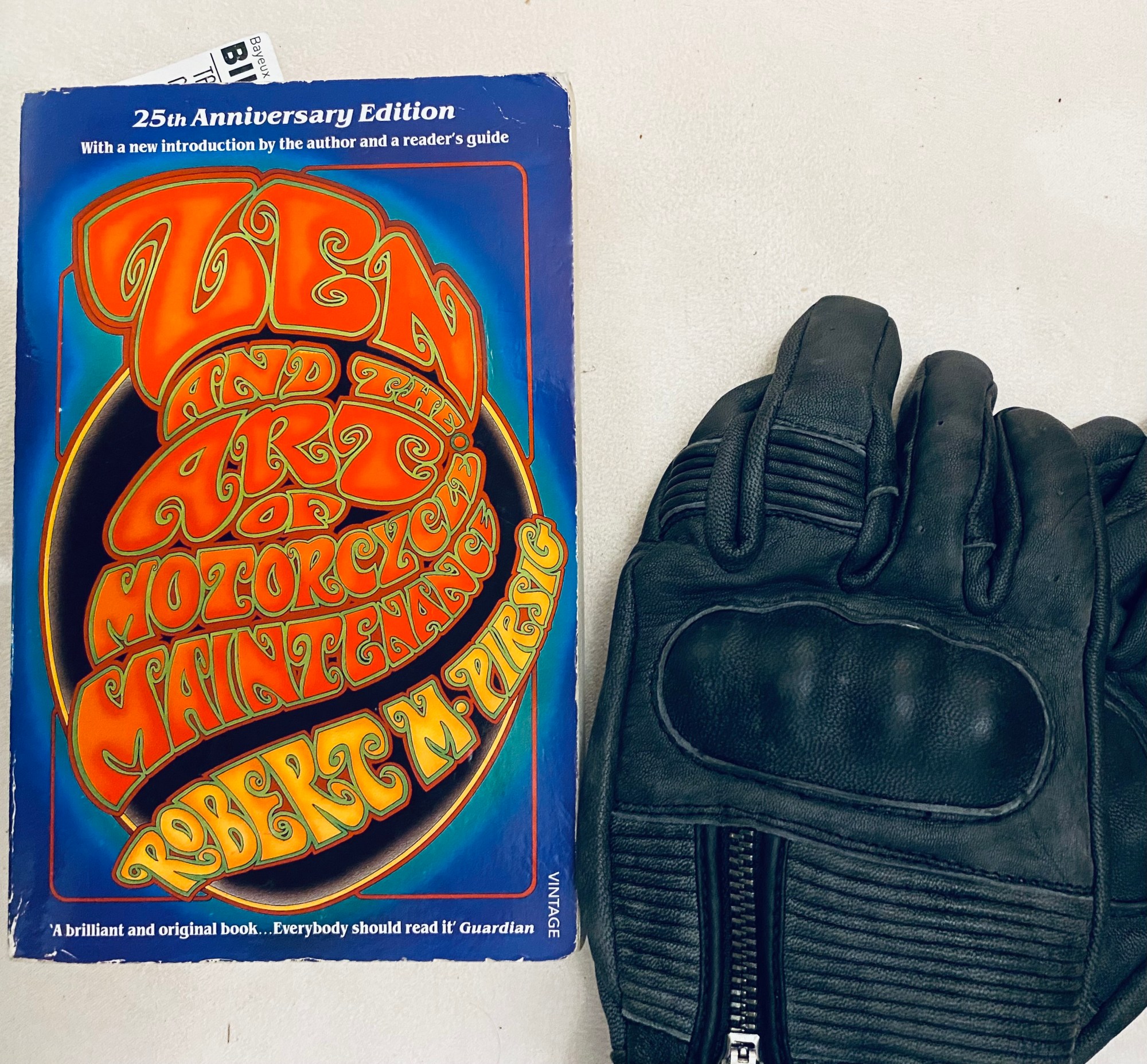
At the end of my previous post, I think I possibly went off at the deep end with fascism, climate change, and Phaedrus, and my readers are owed an explanation, so I’ll attempt one and hope that it proves satisfactory.
You all know that I’m no philosopher, and I’m certainly no literary critic. I’m barely a student of literature, and yes I’ve read a few of the classics but I never finished War & Peace, and hardly started Ulysses before giving up. So I plead for tolerance and indulgence as I attempt to explain what I meant.
If then you don’t want to read yet another biker amateur banging on about ‘Zen and the Art of Motorcycle Maintenance’, ‘Don Quixote’, Haruki Murakami, and a bunch of concepts I only just understand, look away now. Otherwise strap in for two thousand words which mostly serve as waymarkers for gaps in my own knowledge, which if you’re better read than me – not difficult – may at least prove entertaining, until we get back to the terrifying subject of climate change by which time no one will be smiling.
In my previous blog post about Zaragoza I wrote: “When I rode around Europe in 2018, my own Phaedrus then, the monster pursuing me throughout my ride, was fascism. In 2023, it’s climate change”, and left it that, in anticipation of an explanation to come. But when I began to think about what I meant, I realised that whilst it made some kind of chaotic sense in my own mind, it’s actually quite difficult to connect the dots in an entirely logical fashion which takes into account all relevant data points and their place in the narrative sequence.
TW (trigger warning): psychological trauma, ableist language
I’d like to break that down if I may. Phaedrus is the name of a character or perhaps archetype in Robert Pirsig’s epic on the nature of quality and mental illness ‘Zen and the Art of Motorcycle Maintenance’. I think Pirsig possibly used the name of a negative character from Plato’s ‘Socratic Dialogues’ but I don’t know enough about it to offer an opinion, having never read any ancient Greek philosophy. In any case, in ‘Zen’ the character of Phaedrus is used to denote the narrator’s alter ego. He is the part of his personality which left him when he was subjected to electric shocks to “treat” his “insanity” – Pirsig’s word, not mine. Thus Phaedrus is the narrator’s past self, separated from the present self at the point of a psychological breakdown or soon in its aftermath. The narrator is afraid that Phaedrus will merge with him once more, returning him to a state of “insanity”. He is not afraid of Phaedrus, but rather of this merging.
In this reading, in ‘Zen’ Phaedrus is a kind of monster in the Haruki Murakami sense: for example the sheep in ‘Wild Sheep Chase’ is hardly a horror movie creature, but its reality altering presence, though neutral for the sheep, is antagonistic and malevolent to those who must exist in its universe. And so Phaedrus, in my own interpretation of ‘Zen’ at least, is a similarly malevolent presence which once held some power over the narrator. This to me is akin to a Murakami-style monster, although his apparent malevolence may be the narrator’s doing after all.
As a curious tangential observation, in a way it’s interesting that my own limited understanding of Pirsig’s philosophical concepts is Dionysian, or romantic, in nature. I don’t have the diligence to go back through historical and literary works and research the source materials upon which they are based as someone with an Apollonian, or classical, mindset would. Instead, I view them as ready made for me to grapple with, rather than understanding their building blocks. Whilst Pirsig doesn’t necessarily pass value judgement about which approach is correct, his own is obviously classical, as he writes, although he aspires to a harmony between the two. Nonetheless chances are he’d possibly regard me as deluded. “LOL”, as some might type, or perhaps react with a laughing emoji. Which is a Dionysian response in itself. Unless you actually think about it, in which case it’s Apollonian. Etc.
Of course Robert Pirsig’s Phaedrus is decidedly not climate change nor indeed fascism. He is not really a concept although he does represent mental illness or at least the thing which designated the narrator as being mentally ill previously, and portents its possible return. In my attempt at pithiness, I missed a crucial link between concepts and their proxy or signifier.
Here is what I meant: “my” Phaedrus during my long ride around Europe in 2018 was not fascism per se, rather it was my own gradual and initially undefined recognition of the spectre of fascism, with its roots in the past but looming and intimidating and ever present, albeit initially abstract. It was the uncomfortable sense that there was something following me around or appearing in some way in places I visited: neo nazi graffiti here, inter-communal strife there, the occasional racist remark, the emotional imprints of passing through places like Dresden or Guernica. In this respect it was a useful and not unhelpful apparition, in that it eventually helped a certain understanding to form in my mind, and actually resulted in some hard questions I asked at the outset of my journey in 2018 being partially answered. Not that I necessarily enjoyed the answers, but I’d brought that on myself.
And so it is this time. The spectre revealing itself gradually and more starkly by the day, this ever present haunting, is not climate change per se, rather it’s my own understanding about what’s happening. The day after leaving Zaragoza I begin to realise that several events, including the flash flood and the heat, form a pattern and the answer is obvious: climate change. Phaedrus is the manifestation of the uncomfortable process of discovery, which of course becomes more frightening with each revelation and affirmation of the full destructive horror of climate change.
As I ride covering hundreds of miles of arid Spanish landscapes, my mind turns to another traveller, Don Quixote. He was only “insane” in one, outdated, definition of the word. In truth he wanted adventure at all costs, and that is a driver which many of us motorcycle adventurers experience, or we wouldn’t be out there on our bikes, riding through deserts, mountains and tundra.
The windmills have been replaced by wind turbines, and my horse is made of metal. I hope that I am not as delusional as Don Quixote, but I do recognise parts of him in me. I ask difficult questions, arising from a decidedly romantic, not classical as Pirsig would prefer, world-view, and when the Road and her sister Reality hand me stark answers, I don’t always like them. I do not bury my head in the sand about climate change, and have minimised my own impact and carbon footprint as much as possible: we have solar panels on our dwelling, we eat a plant based diet, I have not bought a new item of clothing in several years, I reuse, upscale and repair everything. But climate change is terrifying, and more so when it’s not someone on the news in a distant country getting hit by a potentially deadly flash flood, it’s you.
In 2021 I went to Glasgow for COP26, the 26th UN climate conference aimed at reaching an international consensus about what we must do in order to prevent an irreversible climate collapse. I rode 500 miles there from London, with the last 50 miles or so being through torrential rain. When I got there I was shocked by the levels of prevarication, delusion, denial and self interest which I observed among many who made the journey. And yet merely by being present, I was in some way already legitimising those behaviours by participating in the discourse. I challenged it, yes, but also gave legitimacy to it by engaging with it, albeit from a critical stance.
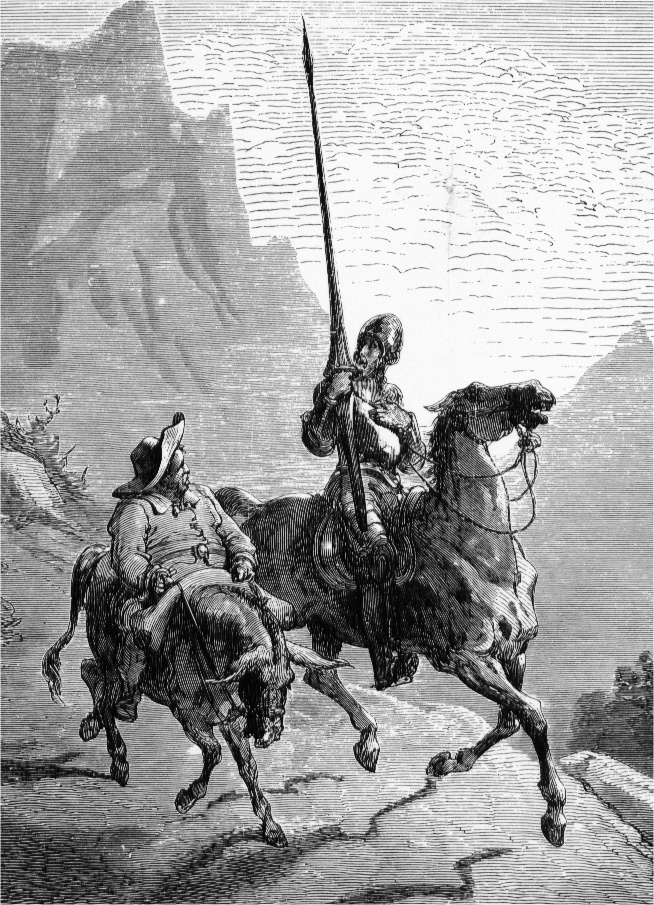
What would Don Quixote do if he met Phaedrus? If his reality truly was challenged, beyond his delusions of valour, if it was existential for the whole of humanity, as it is now with climate change? He would fight the realisation at first. But would he eventually come to understand that he could be putting his lance to better use than chasing shadows? Would he? And what would Phaedrus do? At the end of ‘Zen and the Art of Motorcycle Maintenance’ it’s Phaedrus who forces a resolution, speaking through the narrator to comfort his son. So might the monster hold the answer, as long as you acknowledge him?
I asked an AI what would happen during such an encounter, of two different kinds of so-called “insanity”, a term which Pirsig himself used which has not stood the test of time. Here is what it came up with.
—
A short story
Of Dust and Valour
In the arid expanse of a Spanish desert which not so long ago used to be a bountiful vineyard, two figures appeared on the horizon. One was mounted on a thin white horse, clad in ancient armour, with a lance raised high. It was Don Quixote, the old intrepid knight-errant, ever on the lookout for adventure. The other was a man astride a matte black motorcycle, wearing a dusty motorcycle jacket, a battered open face helmet, and with a troubled expression on his face. It was Phaedrus, the philosopher seeking a different kind of truth.
As they drew closer, Don Quixote’s eyes glinted with chivalric fervour, and he proclaimed, “Halt, stranger! For I, Don Quixote de la Mancha, challenge thee to a noble duel! Prove your valour, or retreat in shame!”
Phaedrus was taken aback by the sudden encounter but tried to reason with the valiant knight. “Hold, good sir! I am Phaedrus, a mere philosopher, not a warrior. I have no desire to engage in combat. Let us discuss the nature of reality and the essence of being instead.”
But Don Quixote was resolute, convinced that he faced a formidable foe. “A philosopher, you say? Fine words and wisdom may have their place, but they shall not dissuade me from the path of honour and valour!”
Phaedrus sighed, realising he could not easily persuade the unwavering knight. Seeing that Don Quixote was prepared to do battle, Phaedrus knew he had no choice but to accept the challenge reluctantly. “Very well,” he said, “if a duel is what you seek, then let it be.”
The motorcycle engine hummed, and Don Quixote readied his lance, preparing for the clash between the old world and the new. The sun beat down upon the sandy arena as they circled each other, Don Quixote’s steed prancing gracefully, and Phaedrus manoeuvring his motorcycle with deftness.
Don Quixote charged forth with fervour, his lance aimed at Phaedrus. Phaedrus, with a mixture of skill and reluctance, evaded the first thrust. He called out, “Don Quixote, please, we don’t have to do this! There are better ways to resolve our differences!”
But the old knight was undeterred. He continued his assault, swinging his lance with surprising agility for a man of his age. Phaedrus deflected and dodged, his motorcycle’s wheels kicking up dust, but he refused to retaliate with full force, still hoping to avoid bloodshed.
Don Quixote’s resolve seemed unbreakable, and he persisted in his attacks, spurred on by the belief in the righteousness of his cause. “You may be clever with your contraptions, but true valour lies in the heart and the spirit of a knight!” he shouted.
As the battle waged on, Phaedrus began to understand that some conflicts could not be resolved through words alone. He realised that despite their differences, Don Quixote’s adherence to his code of honour held a certain nobility. In that moment, a sense of mutual respect and admiration began to grow in Phaedrus’s heart.
With one final, mighty charge, Don Quixote unseated Phaedrus from his motorcycle. The dust settled as Phaedrus lay on the ground, defeated but unharmed. Don Quixote lowered his lance and looked upon Phaedrus with a newfound gentleness.
“I have won this battle,” Don Quixote declared, “but I see in you a spirit akin to my own, an explorer of truths in your own right. I shall not take your life this day, for I sense that we are kindred spirits, questing for meaning in our own distinct ways.”
Phaedrus, grateful for the knight’s mercy, rose to his feet and extended a hand. “Thank you, Don Quixote,” he said, “perhaps there is more to honour and valour than I previously believed. Our paths may differ, but I see the strength in your convictions.”
With that, the two warriors shared a nod of understanding, bridging the gap between their worlds. As the sun began its descent, they parted ways, each carrying a newfound appreciation for the other’s journey. Though they remained dedicated to their own quests, they knew that the desert encounter had left an indelible mark, connecting them across time and space in a unique bond of honour and enlightenment.
—
There are no happy endings, but as long as we have any strength left, it is our duty to attempt to understand each other, to overcome our fear, and to try and better ourselves, for the sake of humanity and the planet. The monsters are powerful, but of our own making.
With big thanks to my friend Christina for sensitivity checking this post.
 Blac Ridere