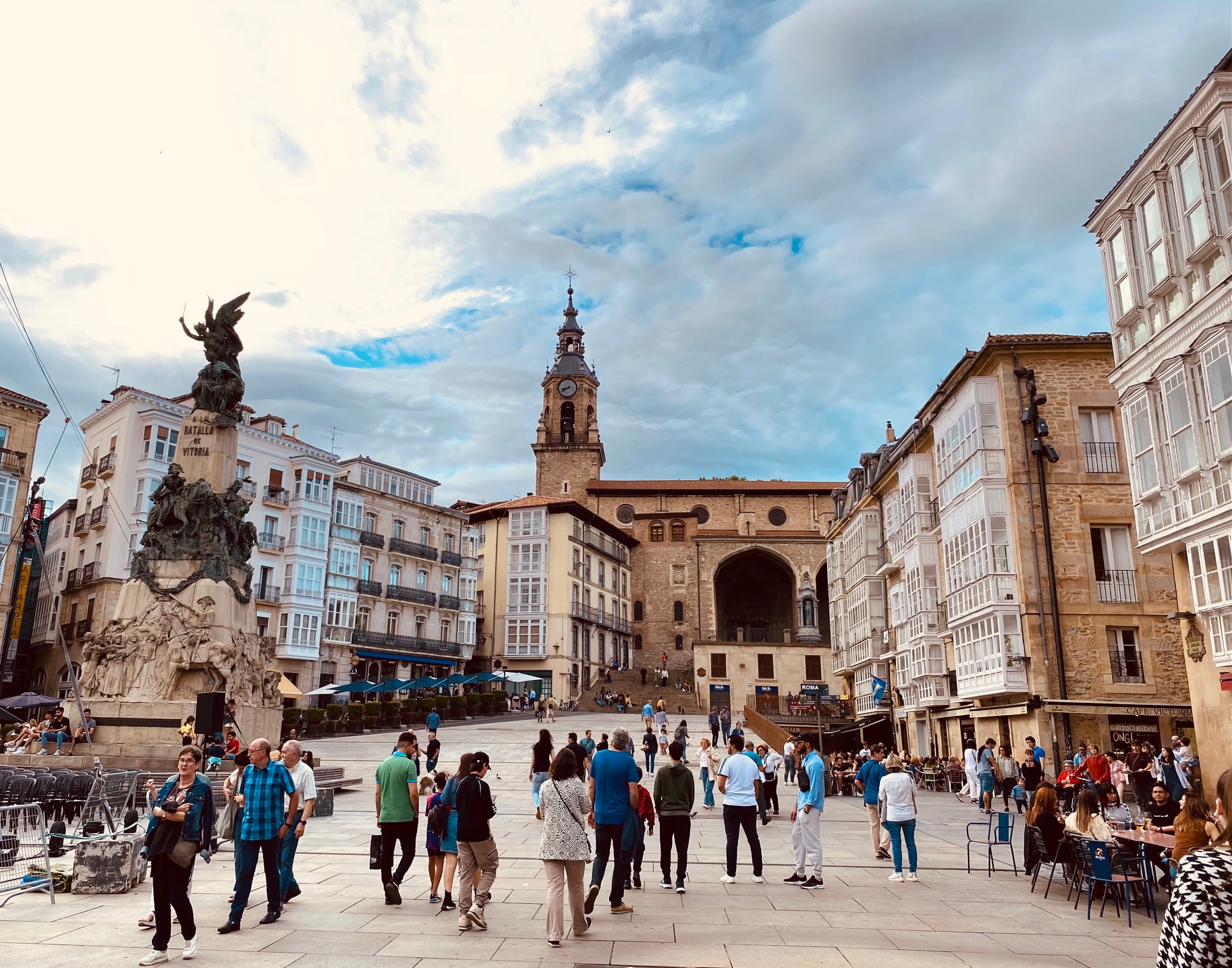
“The future’s uncertain and the end is always near”, sang Jim Morrison. Bikers generally like The Doors, perhaps because the essence of Jim’s poetry speaks to us at a visceral level. Perhaps. The future is indeed uncertain as I set off from Bordeaux towards my next intended stop in Vitoria-Gasteiz.
Breakfast by this stage has become my main and frequently only meal of the day, so I load up on cereal which I reinforce with nuts and seeds, fruit and a pastry, and drink two small cups of coffee. Thus far I’ve found vegetarian food very easy to come by and plentiful. There is ham and sausage on offer, but most of the food items in breakfast buffets are plant derived, or are dairy. In any case, there is enough to set me up for the day, supplemented by an apple, an orange, or a protein or raw bar later on.
I repack the bike, hauling the cruiser luggage onto the pillion seat. I’ve given up on having it in the “correct” position: vertical and on the luggage rack. Horizontal and on the pillion seat works much better, with the backrest and the luggage rack being used to secure it using the many slightly kinky-looking straps.
I tap the relevant coordinates into the satnav and set off. The first hundred and twenty miles or so are uneventful and I cover them in good time. I stop for petrol not far from Biarritz, which I will be visiting later during my trip, take a few sips of water, get back in the saddle and head towards the foothills of the Pyrenees, for the first of the three times I’ll cross them during this trip.
Gliding along in relatively pleasant weather, I begin to relax. Then suddenly everything changes. Literally in seconds and without any warning, I am riding through a wall of water. Visibility is down to a few metres. Even though my jacket and jeans are waterproof the outer fabric is soaked within less than a minute and I can feel the tell-tale coldness of it on my skin. I actually feel the force of the water hitting my chest. It’s coming from all directions: above, below, from both sides, from the front. There is perhaps half a foot of water on the surface, which has begun to resemble a river with actual whirlpools appearing in front of me. There are a couple of moments when a wave hits me and I’m aquaplaning. There is no hard shoulder and stopping is not an option for fear of being wiped out by a lorry which may simply be washed out of its lane. The safest option is to keep moving. I stay in high gear to maximise torque, but slow down to the speed of the largest vehicles which are now doing maybe 70km/h on a 120km/h motorway. I switch on my right indicator, bend my body forward, relax my shoulders and elbows and do my best to respond to each change I encounter calmly, smoothly, and intuitively. “Be water”, Bruce Lee taught us. And right now I’m more water than person. When the downpour hit, I did not have time to close the vents on my helmet and water is now soaking through the top of it and the chinguard, adding to the discomfort and the reduced visibility. My shoulders and elbows may be consciously and deliberately relaxed, but my neck muscles are tight and my jaw is clenched. In my head I’m narrating trajectories and “what if” scenarios, like they teach you in advanced training, and it may be that some of that narration turns into mantras and prayers.
One thing I do not experience is fear. Veronica and I are one unit at this point, and I suppose that makes me a cyborg of sorts. I am focused on riding my best ride, responding to each individual challenge whilst recognising them as part of a longer term arm with the focus being survival. I am conscious that death with its watery grave is near, but I’m not afraid, rather I concentrate on staying out of its path as though it’s one of the giant erratically moving lorries.
As suddenly as it began, the water stops. Just stops. The skies are clear and blue again, the sun is shining. The surface is wet, but it’s puddles, not a river. Traffic returns to 120km/h, and I keep up. The heat is back and I dry within minutes, and that’s that. My first serious brush with death is over as quickly and spontaneously as it began.A couple of weeks on I read of the terrible catastrophic flash flooding in Zaragoza, sweeping away cars, trees and infrastructure, and realise that I’d got off fairly lightly.
At this point I decide that I need a physical and emotional break, and resolve to stop at the first petrol station I encounter. It’s a few miles ahead and when I pull into it, I realise with delight that it’s a Repsol, my first one of the trip. As a lifelong Honda rider, I have a soft spot for Repsol so I take that as a good omen.
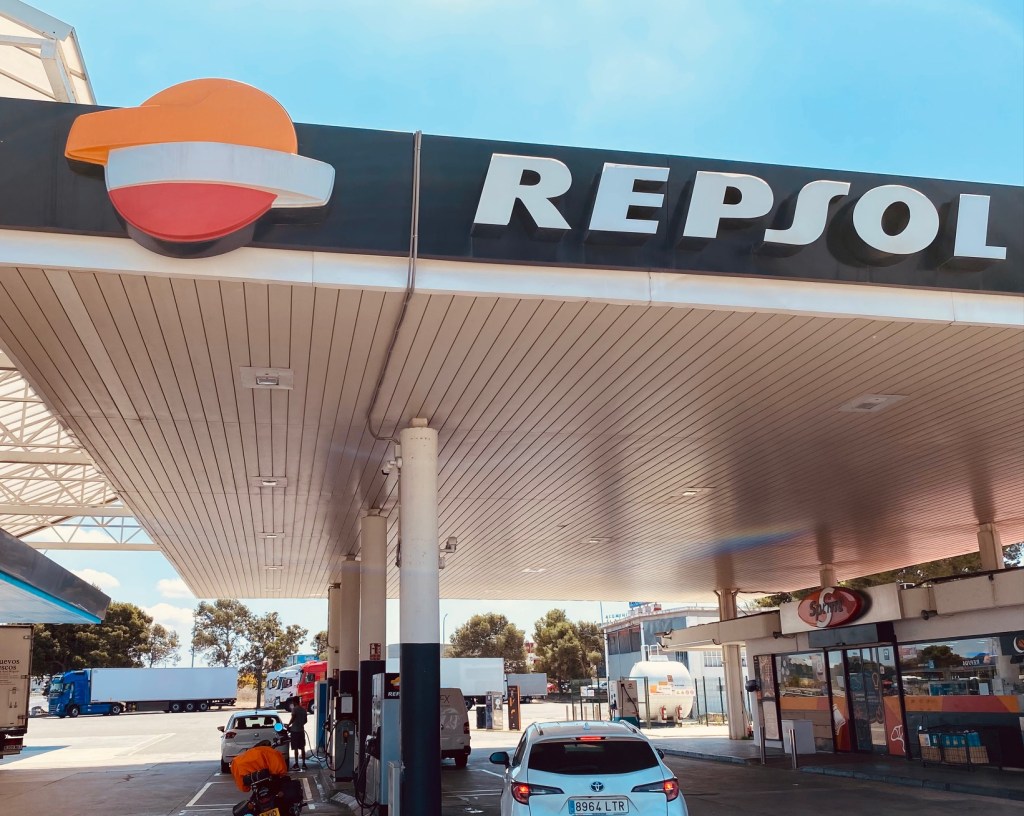
Repsol began its sponsorship of the Honda motorcycle racing team in 1995, marking the beginning of a longstanding partnership that has left a significant impact on the world of motorsports. With their distinctive orange and white livery, Repsol’s branding became synonymous with Honda’s racing colours. Under Repsol’s sponsorship, two exceptional riders, Marc Márquez and Dani Pedrosa, achieved huge success in MotoGP. Marc Márquez, one of the greatest riders of his generation, rode for Repsol Honda from 2013 to 2020. During his tenure, riding under his now famous number 93, Márquez secured an impressive total of six MotoGP World Championships, claiming the title consecutively from 2013 to 2019. His extraordinary talent and fearless riding style made him a dominant force on the track, establishing him as a true icon in the sport.
Dani Pedrosa, another highly accomplished rider, was a member of the Repsol Honda team from 2006 to 2018. Throughout his career, Pedrosa showcased exceptional skill and consistency, earning three MotoGP World Championships as he secured the title in the 125cc class in 2003, the 250cc class in 2004 and 2005. Riding Honda motorcycles, Pedrosa’s success showcased his versatility and determination, cementing his reputation as a formidable competitor.
The partnership between Repsol and Honda, along with the incredible talents of riders like Márquez and Pedrosa alongside others, has resulted in numerous championships, race wins, and podium finishes. Their collaboration continues to captivate fans (me included) around the world.
Repsol filling stations are eminently civilised. They are clean, logically laid out and with helpful staff. I fill up, knock back a coffee, sip some water, and I’m ready to face the next phase of the ride once more.
There is not far to go to Vitoria-Gasteiz, and I arrive in the late afternoon. The motel is a brutalist building with ample parking directly outside the front entrance, and huge rooms inside. I get allocated a room on the first floor with a good view of the bike, and the nice receptionist also offers to keep an eye. It’s as nice an arrival as any. Then, I find myself surrounded by twenty or so young men. They are in their early twenties and all look identical: tiny narrow shoulders, pigeon chests, huge powerful buttocks and thighs, and all wearing fluorescent pink and green skin tight lycra which leaves nothing to the imagination. For added entertainment they are all wearing those hard soled clippety clop shoes which make them walk like a cross between Bambi and a CGI dinosaur. This cycling team is the campest thing I’ve seen in a long time. They’re personable guys, and we exchange a few pleasantries whilst waiting for the lift.
Vitoria-Gasteiz, the capital city of Spain’s Basque Country, boasts a rich and fascinating history that dates back centuries. Its origins can be traced to the mediaeval era when it was founded as a fortified village. Throughout its history, the city has experienced large transformations and played crucial roles in various historical events. Vitoria-Gasteiz witnessed the Battle of Vitoria in 1813, a key moment in the Peninsular War, where the British and Spanish forces defeated the Napoleonic army commanded by Napoleon’s brother Joseph.
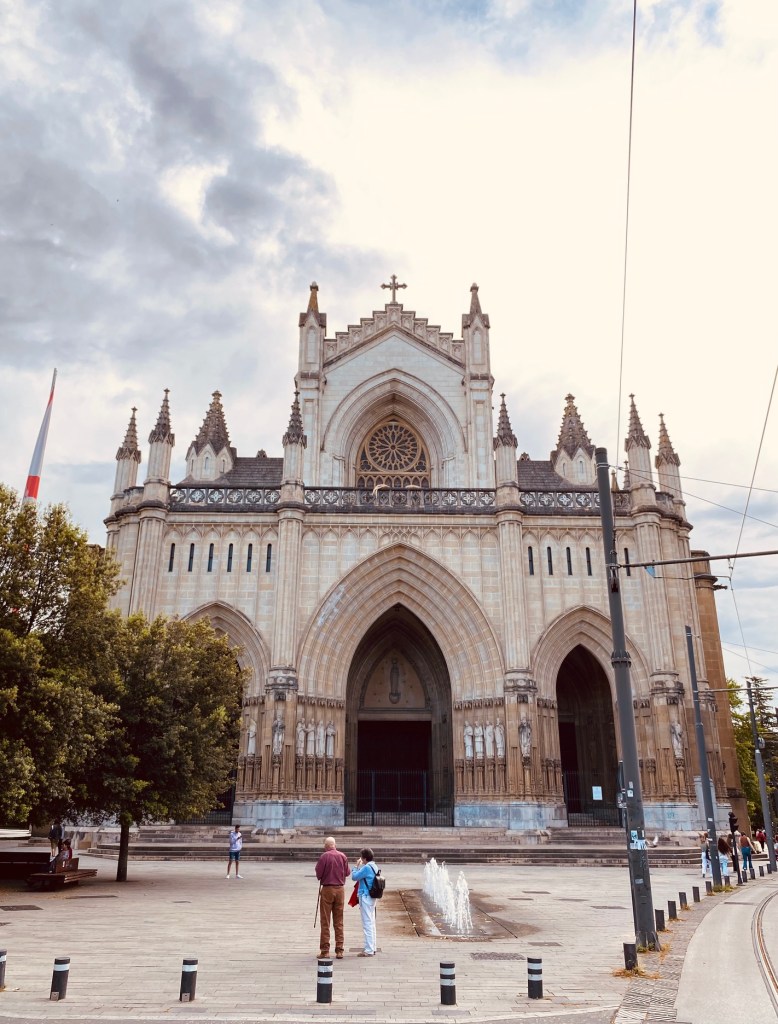
The city also holds major significance in the Basque culture and identity, serving as a hub for Basque language, literature, and traditional festivities. Vitoria-Gasteiz has developed into a modern city, known for its well-preserved historical centre, with charming narrow streets and beautiful architecture. It has also become a centre for innovation and sustainability, earning recognition as the European Green Capital in 2012.
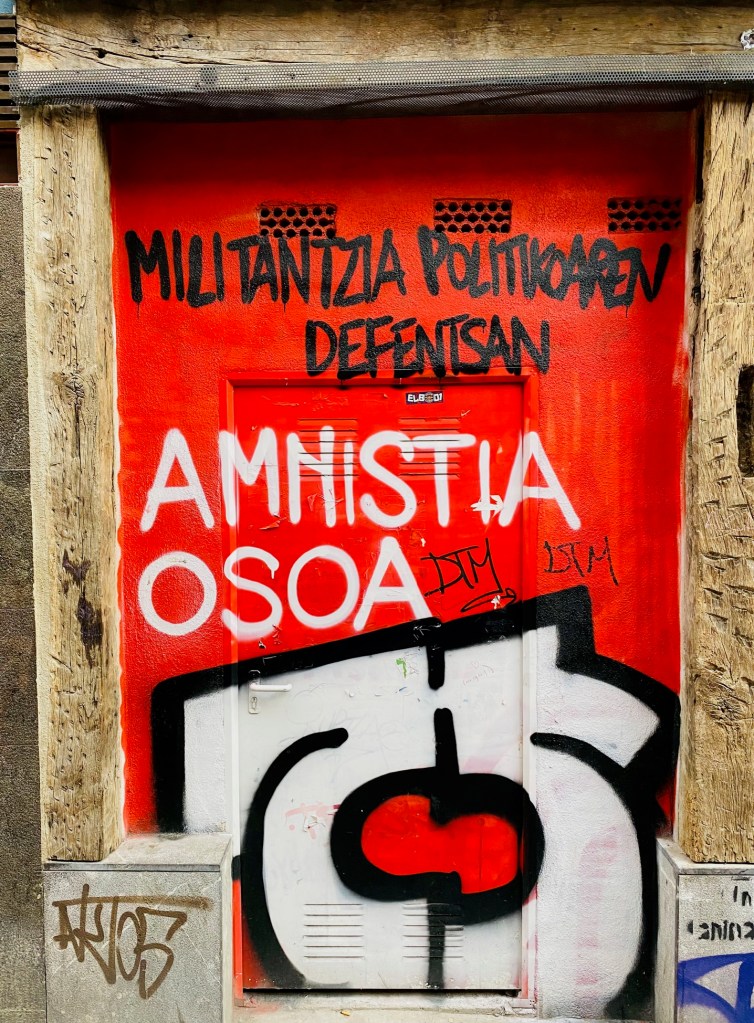
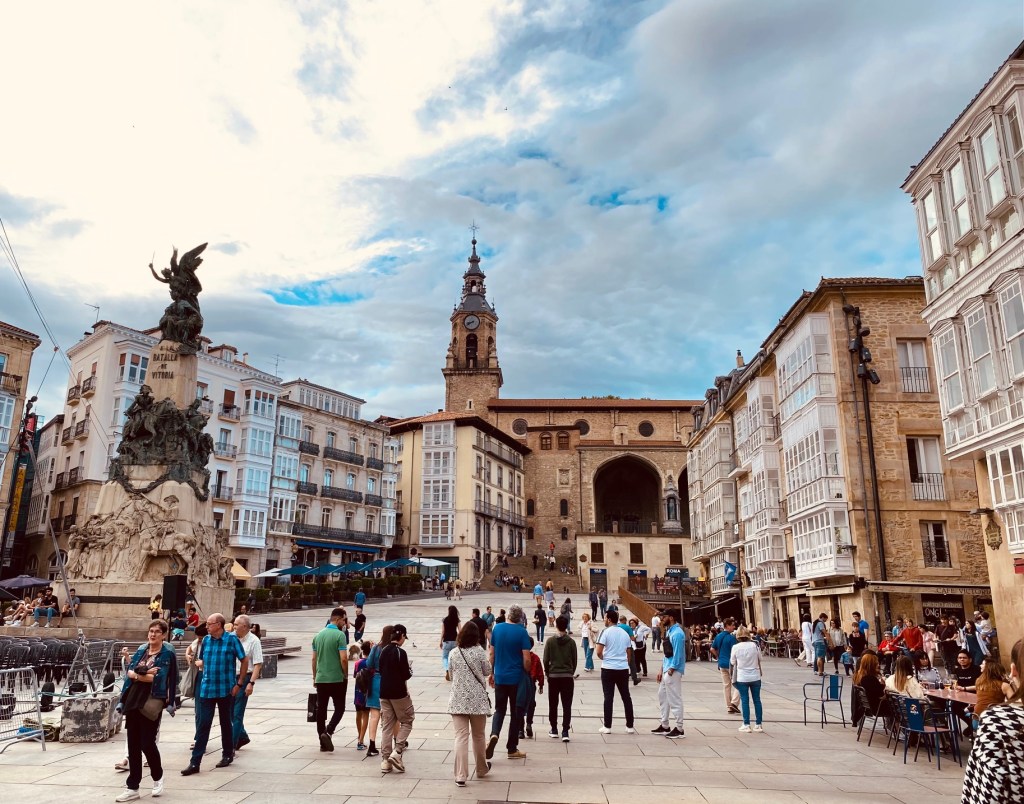
Since I’m in the Basque Country, I decide that I deserve pintxos. I walk into town, about 45 minutes or so, taking in the street life and architecture. The evening is buzzing and I pass the beautiful buildings, cool looking bars and political graffiti. Motorbikes are everywhere, and people park them where they like. Every apartment block has a dedicated area for motorbike parking.
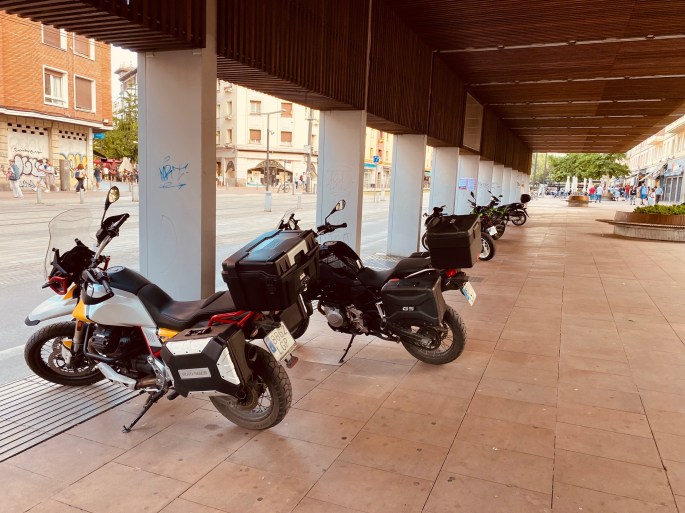
However every hospitality establishment I look at seems to be focussed more on drinking. Eventually it occurs to me that I’m not actually hungry and after an hour and a half of walking around the old town and enjoying the sights, I decide to skip food and head back to the motel to get some rest.
As is my routine, I wake at 7am the next morning, shower, pull on my jeans and T shirt and head down to breakfast. It’s thronging with the young cyclists, but they don’t seem to be too interested in my staples, coffee and fruit, so I have those sections of the buffet pretty much to myself. I load up on what I need, head back to my room, repack, drag my awkward cruiser luggage down to the bike, reload and head towards Leon.
 Blac Ridere
One thought on “The Long Ride South (part 2: a Brush with Death)”