It’s still dark when I wake up. I’d prepared and laid everything out the evening before so all I need to do is shower, get dressed, eat and drink something, put my kit into the panniers and head out. The evening before the receptionist asked me to post the key to my gite through the letterbox of the main gate, as no one would be up at the ungodly hour I must depart in order to beat the heat. I post the key through the slot in one of the gate pillars on my way out and head West out of Biarritz.
Since it’s dark when I leave and since I’m riding West I’m chasing the rapidly departing night, although soon enough the horizon ahead of me turns indigo, then azure, and then the pink haze begins to spread from behind me over my head, seeping into the the sky before me. By this point I’m already in the foothills of the Pyrenees, having decided to cross them for the third time on this trip via the most direct route available. Soon enough the mountains surround me, but I get little opportunity to admire them because all of a sudden all I can see is white. I’ve entered a cloud, and it’s a whiteout. I can just about make out a lorry in front of me, slowly making its way through the fog, its hazards flashing. I get close enough to see it, and remain at that distance at its tail. Seeing as we’re moving slowly and I’m sticking to the right hand lane, I switch on my right indicator, to decrease the chance of being rear ended.
Near zero visibility aside, it’s not so bad. Progress is slow, but consistent. At the back of my mind is the thought that every moment’s delay now will mean more time in the deadly heat later, but it’s simply not safe to overtake, and besides I wouldn’t actually be able to move very fast anyway in a whiteout on a windy mountain route.
A few kilometres of this and the uninterrupted wall of white becomes patchy and then translucent. Some visibility returns. I increase the distance between myself and the lorry so I’m no longer tailgating it, and eventually there is enough visibility to attempt on overtake, which I do cautiously.
As I progress the cloud turns into water droplets, and then it becomes mundane rain, whilst the terrain takes on a distinctly urban character. I grind my way through it. Visibility has improved insofar my visor covered in droplets will permit me to see. I keep it going by maintaining the same rhythm as the vehicles around me. Death is not on the agenda as far as I’m concerned. But for the first time on this trip, during my third crossing of the Pyrenees in as many weeks, I begin to wonder whether I’d bitten off more than I can chew.
Another 30 minutes, and the rain begins to dissipate. Soon the skies are blue and all of the built up patches of landscape are behind me. I enter a clear highway with what I perceive to be a typically Spanish vista before me: a clear prairie with mountains looming in the distance. The way to Zaragoza is relatively clear of traffic. The extreme heat is some way off, so I find 75mph on the throttle and stay largely at that velocity, changing it only when I need to change lanes in order to overtake slower moving vehicles.
For the first time I’m really noticing the road signs for place names which have always figured strongly in my own mythology of Spain: Rioja, Aragon, Navarre… Riding conditions are OK, and that means I have the opportunity to ponder how the mythos of Spain present in my own mind, largely embodied by Cervantes and not much else besides, actually fits in with the historical truth of Spain, its people, and those they fought and eventually subjugated.
Let us start, then, with the fact that the entity which some of us think of as “Spain” is a much more nuanced concept. Wittgenstein argued that language is defined by its usage. Is it possible to turn that philosophical proposal on its head, in that case? Can “usage”, or rather “definition” (yes, you see what I mean?) be defined by language?
The Spanish language, known natively as “español” or “castellano”, traces its origins back to vulgar Latin brought to the Iberian Peninsula by the Romans during their conquest in the third century B.C. Over the centuries, this form of Latin gradually evolved into several distinct Romance dialects, of which Castilian, named for the central region of Castile (or Castilla in Spanish), became the most prominent. The process was heavily influenced by historical events, such as the fall of the Western Roman Empire, the influx of Germanic tribes like the Visigoths, and the Moorish invasion from North Africa, all of which contributed linguistic elements to the language. Castilian began to be recognized as a separate language around the 10th century, and its growth was significantly accelerated during the Reconquista (8th-15th centuries), as Christian kingdoms in the north gradually reconquered the Iberian Peninsula from Muslim rule.
The Kingdom of Castille played a pivotal role in the development and spread of the Spanish language. As one of the most powerful states during the Reconquista, Castile extended its political, cultural, and linguistic influence across the peninsula. The language’s standardization began with the publication of the “Cantar de Mio Cid” (The Song of my Cid) in the 12th century and was solidified by the “Las Siete Partidas”, a legal code completed under the rule of Alfonso X “the Wise” in the 13th century, who promoted the use of Castilian over Latin. The definitive turning point came in 1492, with two landmark events: the completion of the Reconquista with the capture of Granada, and the publication of Antonio de Nebrija’s “Gramática de la lengua castellana”, the first grammar of a Romance language. These events laid the foundation for Spanish to become the global language that it is today, especially following the exploration and colonization of the Americas, where it spread extensively.
So it’s not actually “Spanish”, it’s “Castellan”. Indeed, trying to navigate the Barcelona city government website, I’m presented with three options: Catalan, Castellan, and English. Not Spanish, but Castellan. The Kingdom of Castille subjugated others: Leon, Aragon, Catalunya, Valencia. Eventually it pushed out the Moors, taking control of the likes of Cordoba and Seville. What we now know as Spain is in fact an expanded Castille with some regions retaining their pre-Castillan conquest identities more strongly than others.
As I make my way in the direction of Zaragoza rolling in parallel to the southern side of the Pyrennees, the cool mountain air changes with the terrain, becoming drier and warmer. I dry quickly, and I can tell that the temperature is nearing 30 degrees. By the time I stop for petrol for the first time, it’s in the mid thirties. Not unbearable, yet, but we’re already at the lower end of the danger zone. I fill up, drink water, eat a piece of fruit, apply a generous gloop of sunblock, ensure my jacket is partially unzipped and the vents on my lid are wide open, and set off forth. I’m now keeping my velocity relatively low, around 70mph and below the speed limit, so as not to over work Veronica’s engine. Then I’m riding directly into the Sun, headed South East, but it’s moving through the sky comparatively fast and soon I’m no longer facing it as it moves to my right. The horizon ahead is now a kind of haze like you see in Westerns or animal documentaries, and the scenery is almost wobbling, as though the sky and distant mountains are a picture on which the paint or ink has melted slightly and is running in the heat. I slow down some more, to about 65, and stay there: any faster and the engine may start grumbling, any slower and the breeze generated by the motion won’t be strong enough to cool me down. I stop again, and again, maybe about every 100 miles. Veronica goes in the shade, I drink water, and reapply sun block. The epicentre of the heat is somewhere between Zaragoza and Lleida. I pass Zaragoza for the third time, now a familiar landmark. Little do I know that it’ll soon be devastated by flash floods, which like this heat and other extreme weather events are becoming more frequent and more destructive.
There go the bulls again, looming over the highway from their lofty hilltop vantage points. I acknowledge them but my focus is on maintaining a steady pace, not too fast, not too slow, and paying attention to how I’m feeling in the heat. After passing Lleida I make another pit stop. I’m no longer in the epicentre of the heat, and the temperature is a hot but tolerable 38 or so. I drink water and sit in the shade for a bit, letting the engine cool down, before saddling up one more time and heading out again. By the time I reach the coast, the temperature has fallen to around 32C or so and I congratulate myself on surviving, this time, the most extreme heat I’ve ever ridden through to date, through planning, common sense, and keeping a cool head, as it were, literally.
I get back to Barcelona by the mid to late afternoon and head back to the apartment which my cousin from Berlin has rented, where my family is staying. They’ve had a good few days in Barcelona in my absence and tomorrow some of them leave and others are due to make our way along the coast towards Valencia.
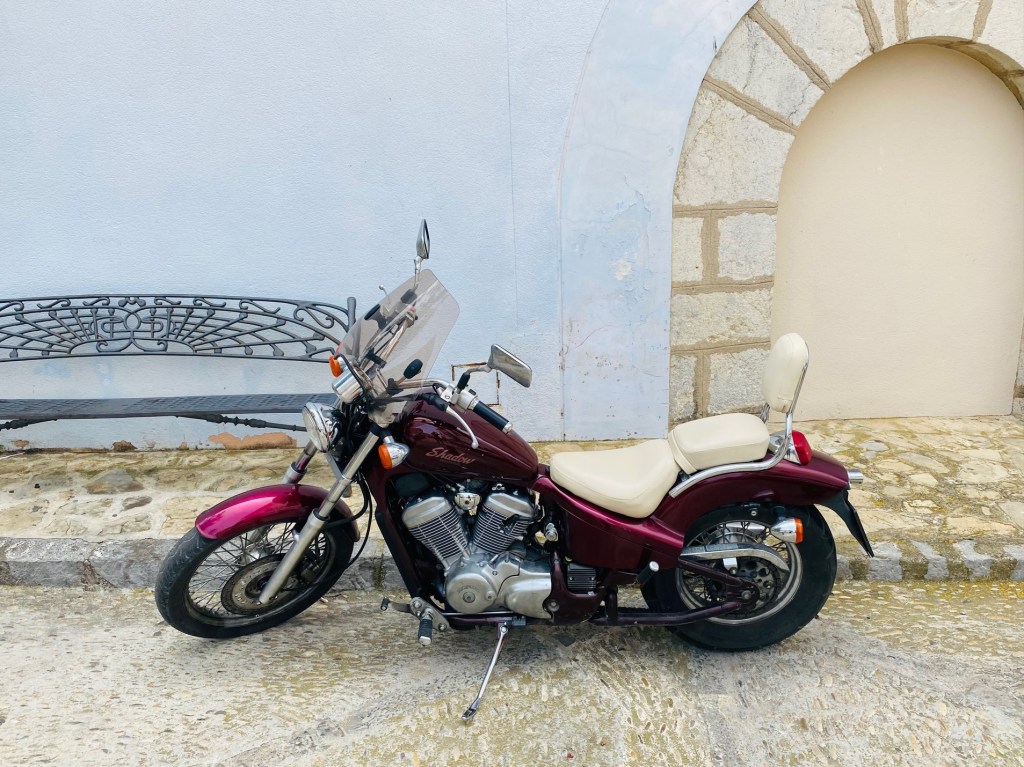
Our first stop the next day is Cunit. Various members of our party drive or or are driven, I follow on the bike. It’s about 40 miles from Barcelona and we all get there quickly. Cunit is a coastal town located in the province of Tarragona. The region has a rich historical tapestry, with archaeological findings dating back to the Iberians and Romans, although the town itself was not officially documented until the 12th century. Over the centuries, Cunit was a small and quiet agricultural and fishing village, often subject to the larger geopolitical changes taking place in Catalonia and Spain. It was only in the mid-20th century, with the rise of tourism along the Costa Daurada, that Cunit started to transform into the more bustling locale it is today.
In the present day, Cunit is a charming seaside town known for its beautiful beaches and a pleasant Mediterranean climate, making it an attractive destination for both national and international tourists. Its three kilometres of sandy coastline and blue flag beach status draw many visitors during the summer months. The town also boasts a busy cultural calendar, with festivities such as the Festival of Saint Antoni, my namesake and the town’s patron saint, and the popular ‘Havaneres’ singing festival. Despite the influx of tourism, Cunit has managed to maintain a tranquil atmosphere and offers a blend of Catalonian heritage with modernity. Additionally, Cunit’s convenient location, close to Barcelona and Tarragona, makes it an appealing place for those seeking to combine the tranquility of seaside living with proximity to major conurbations.
Our host is a family friend, a world-famous scientist who has lived and worked at a university in Barcelona since the mid 90s. The itinerary for the next few days is essentially his. Cunit is his hometown, it’s low key and pleasant but we move on relatively quickly, heading south and west, leaving Catalonia and heading towards our next destination, the resort town of Peñíscola.
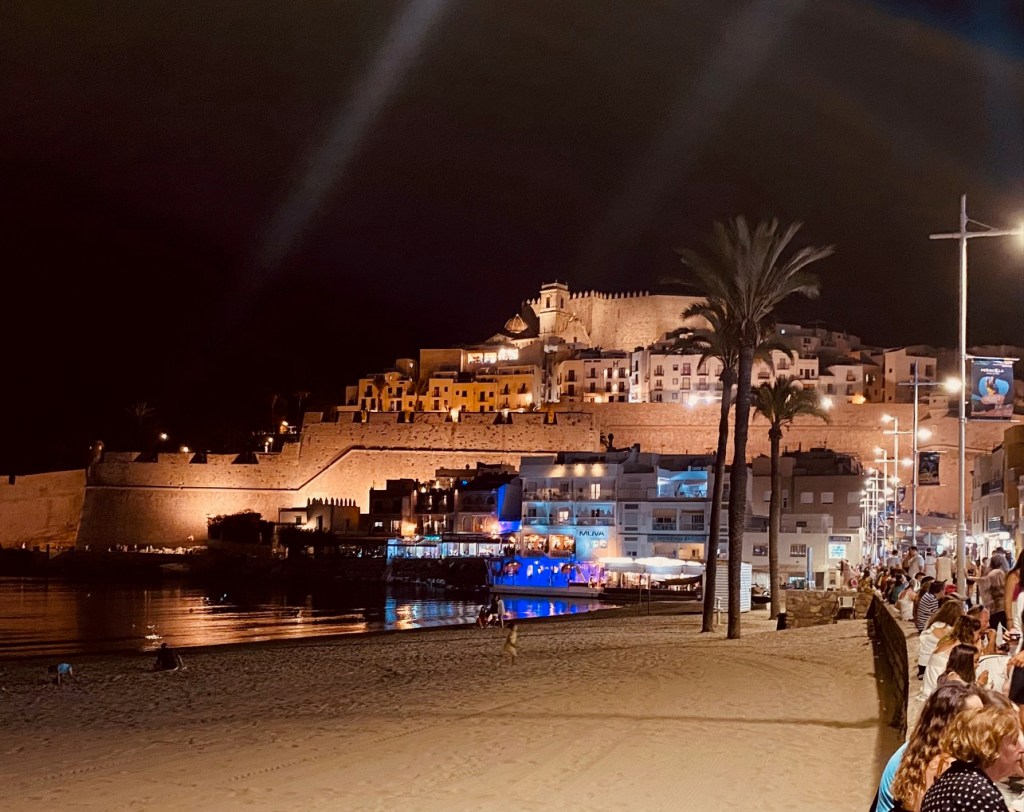
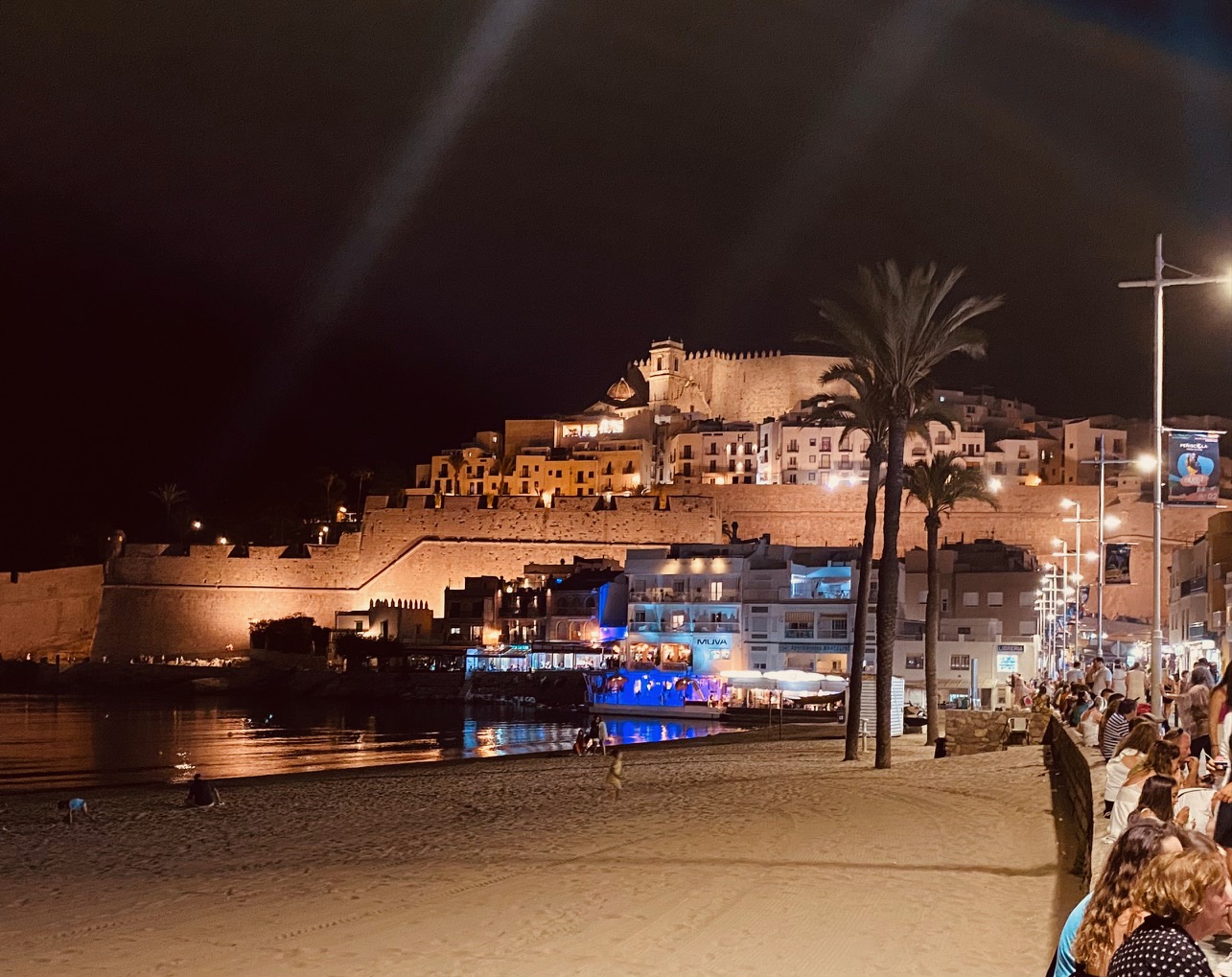
Peñíscola, often referred to as the “Gibraltar of Valencia,” is a fortified seaport located in the province of Castellón, in the Valencian Community. The town is steeped in history, with its roots stretching back some two and a half millennia to the Iberians, followed by the Phoenicians, Greeks, Carthaginians, and Romans. However, the most visible historical symbol of Peñíscola is its castle, which was built by the Knights Templar on the remnants of an old Moorish citadel in the late 13th century. The castle, perched on a rocky peninsula that juts into the Mediterranean, offers a stunning vista of the surrounding area and stands as an enduring testament to the town’s layered history. On arrival and checking into the hotel I swim in the bay underneath the castle, swimming out several hundred metres up to the rocky outcrop upon which it sits.
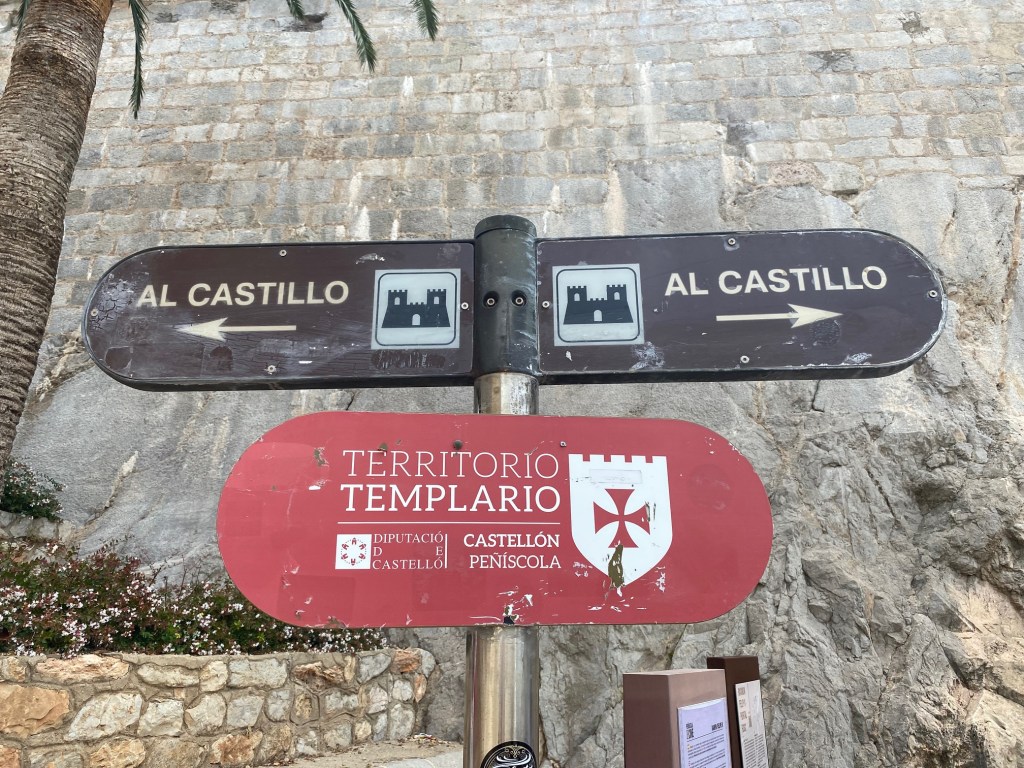
The castle of Peñíscola is famously associated with the Borgia family, one of the most influential and notorious families of the Renaissance period. In 1411, the castle was restructured and expanded when it became the residence of the Antipope Benedict XIII, also known as Papa Luna and more familiarly as Pedro de Luna, who wasn’t a Borgia but was closely related to this powerful family. Later, in the early 16th century, following Pedro de Luna’s death, the castle was acquired by the Borgia family. They were a Spanish-Italian noble family, which produced two Popes, numerous cardinals, and held extensive political power during the Renaissance. This association with the Borgias has endowed Peñíscola with an aura of intrigue and fascination, adding another layer to the tapestry of its history.
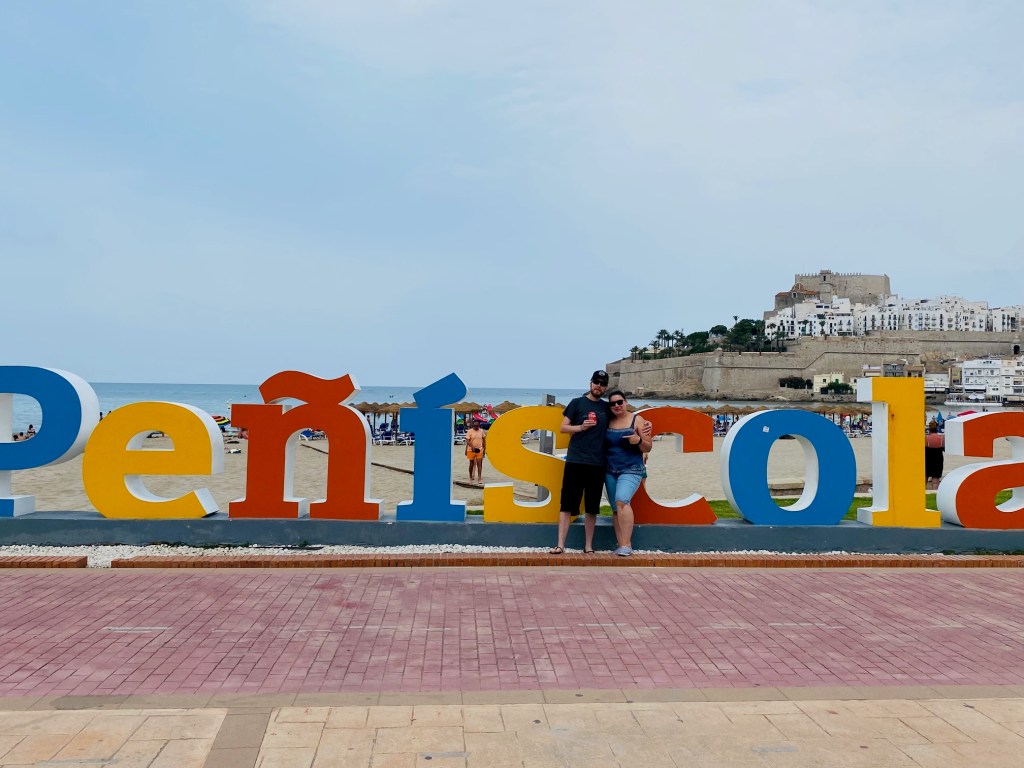
My wife flies out from England to meet with me and the family. This is the first time I’ve seen her in several weeks and her presence makes me very very happy. A few days fly by, and are spent mostly swimming and eating tapas. Our host turns out to be a wine connoisseur and tells us a lot about various Spanish wines.
Spanish wine, with its long history and diverse wine-growing regions, has long held an esteemed position in the world of viticulture. Spain has the largest land area dedicated to vineyards globally, and its diverse climatic zones and terrains have given rise to a variety of wine types, ranging from the effervescent Cava to the robust reds of Rioja. Each wine region in Spain, or “Denominación de Origen” as they are locally known, has its unique characteristics derived from its soil, climate, and grape varietals. The country’s wines are often characterized by their balance between traditional winemaking methods and modern techniques, yielding products that are both rich in heritage and appealing to contemporary palates.
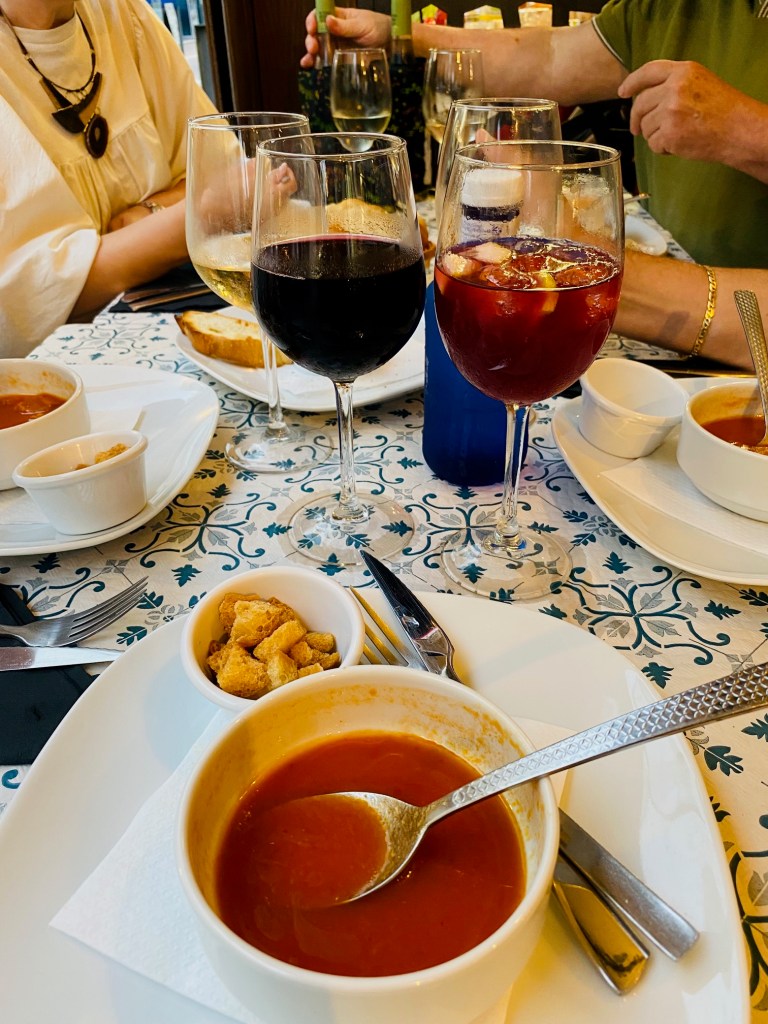
Here climate change rears its head once again. One of Spain’s most renowned wine regions is Rioja, known primarily for its red wines made predominantly from the Tempranillo grape. However, recently there have been challenges for Rioja wines due to climate change. The Tempranillo grape, which forms the backbone of Rioja wines, has deep roots that are adapted to the region’s traditionally moderate climate. As global temperatures rise, these roots, which typically reach deep into the soil to access water reserves during the hot summer months, struggle to cope with increasing dryness and changing precipitation patterns. The resulting water stress affects grape ripening, leading to shifts in sugar, acid, and tannin levels, which subsequently impact the wine’s flavour profile and ageing potential. In extreme cases, the vines could even suffer from reduced yields or failed harvests. The region’s vintners are increasingly concerned about maintaining the unique characteristics of Rioja wines amidst these climatic challenges and are exploring adaptive strategies, from irrigation to experimenting with alternative grape varieties, to ensure the sustained quality and reputation of their products. Needless to say, we don’t drink much Rioja.
All too soon, our time in Peñíscola comes to an end. Vicky flies home and I start making my way back north, via a somewhat convoluted route, but one which snakes its way in the direction of the ship which will eventually take me home.
 Blac Ridere