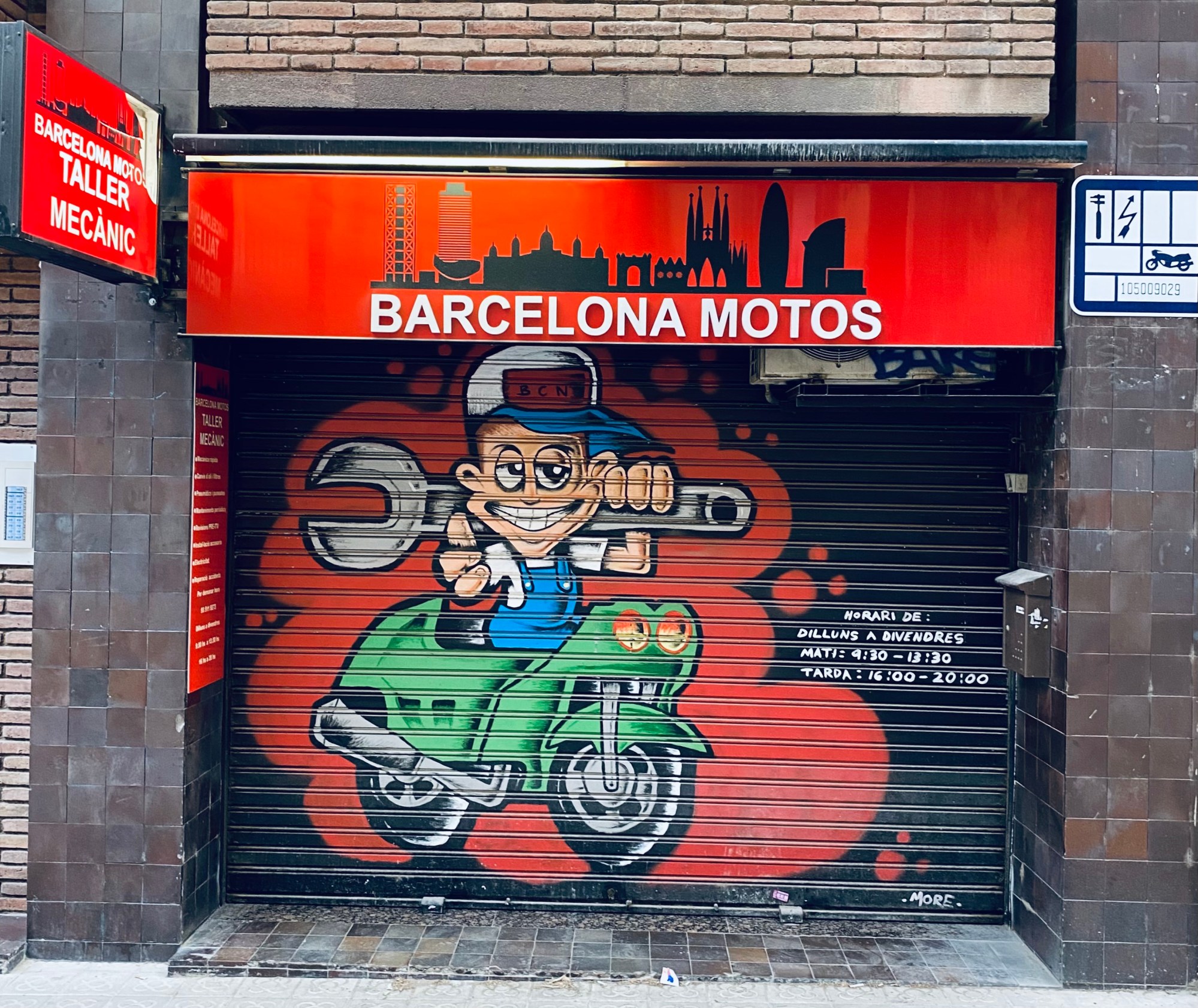
My decision to break the journey up in Zaragoza was made not only because I heard it was a cool city and wanted to check it out, but because it’s only a relatively sedate 200 miles (320km or so) to Barcelona from there. I’m not too hungry at breakfast, so I load up on fruit and coffee, check out and I’m out of the hotel and out of the city by 9am.
I only take one wrong exit at a roundabout on my way out of Zaragoza which is not bad for me: to date I’ve missed a turning or three leaving every single place I’ve stayed in on this trip. The satnav corrects and soon enough I’m en route to Barcelona along the A-2 Highway. The weather forecast looks relatively merciful: no rain and a high of about 30 degrees. I’m wearing a t shirt under my armoured jacket and feeling relatively cool in both senses of the word, and determined to enjoy what I anticipate will be a gentle ride.
Being relatively relaxed, I am noticing my surroundings a lot more than only minding the vehicles I interact with. About 20km out of Zaragoza, I catch sight of the first of two famed symbols of Spain along this route: the Toro de Osborne Alfajarín. This mighty black silhouette of a bull stands tall on the side of the highway, its bold presence an ode to Spain’s heritage. The bull, part of a series of giant bull-shaped billboards initially erected in the 1960s for an old sherry company called Osborne, has transcended its commercial origins to become a treasured emblem of the country’s identity. There are about 80 of them dotted around Spain, and a few in Mexico.
Continuing my ride along the A-2, the anticipation of new sights keeps me fuelled. Before long, I spot another of these magnificent bovines, the Toro de Osborne Pina de Ebro. Proudly positioned above the highway, it welcomes travellers with its majestic figure and timeless allure. These iconic bulls have become symbols of Spain, marking the passage through its monumental and captivating landscapes. They stand not only as guardians of the highways but also as guardians of this nation’s history and traditions. As I approach each one of the two I’m lucky enough to pass, they seem to call out, encouraging me to forge ahead on this adventure, urging me to embrace the spirit of exploration that courses through every motorcycle ride. I am grateful for the opportunity to experience the soul of Spain from the open road, where the journey becomes a symphony of exhilaration, discovery, and cultural immersion.
As I continue along the A-2 Highway, I find myself crossing another remarkable milestone in my motorcycle adventure – the Greenwich Meridian. A thousand or more miles south of London, I pass through the line that marks the division between the Eastern and Western Hemispheres. It’s an extraordinary feeling to know that I’m straddling two distinct parts of the world, and I can’t help but contemplate the significance of this imaginary line. In this moment, I am not just a motorcycle adventurer exploring the rich tapestry of Spain; I am also a wanderer tracing a path which connects the globe’s vastness. The Greenwich Meridian is an observable reminder of our shared human experience, transcending borders and cultures, and in my mind there and then it becomes a symbol of unity that binds us all together. Can you imagine how ridiculous it would be to divide people by which side of that line they come from? And is that any less ridiculous than dividing them by which village they come from, or which side of a mountain range, or a river, or a sea? And yet we spend a lot of time and resources doing just that.
With each passing moment and every mile I cover, the satisfaction of the ride is amplified by the profound encounters with Spain’s awesome landscapes, deepening my connection with the world around me. I am grateful for the privilege to experience this extraordinary adventure. As the journey continues to unfold, I embrace the unknown with eagerness, knowing that every stop, every vista, and every encounter will add another layer to the tapestry of memories that I’ll carry with me for life. Right then, my motorcycle expedition is not just a ride through the landscape; it’s a voyage of the soul, a celebration of life, freedom, and the boundless spirit of exploration.
Then I pass a slow moving armoured security van which bizarrely is disguised as an old school camper complete with the CND logo, despite being at least three times larger. I can’t think of a good explanation for this but one does see many odd things on the Road when one covers a few thousand miles. It doesn’t stay with me for long because I notice a subtle change in Veronica: she seems to be working a little harder than usual as we overtake that odd contraption.
O… K… It’s time to fill up in any case and I pull into the next petrol station. Without the wind of the highway, everything feels stiflingly hot, definitely hotter than the 30 degrees which the forecast promised, but it’s difficult to tell by how much. Veronica is making those little metallic crackling noises as she cools. I give it a few moments, drink a few swigs of water, saddle up and move out. We’re about 80 miles from Barcelona.
The next few minutes are OK. The horizon looks hazy from the heat, and as we pass a small mountain range, I can feel Veronica losing power if we are moving anywhere near the 120 km/h speed limit, and the upward gradient is more than a couple of percent. She’s never done this before, but having ridden this bike the distance equivalent to one and a half times around the equator, I can tell exactly how she’s reacting to which inputs. Her comfort limit is around 105 km/h now, if asked to go any faster than that even on a flat, she makes a little “put-put-put” noise and accelerates in small waves, slowing down each time. It’s the heat. I’m guessing it’s a lot higher than 30. Maybe 35 or 36. I too am feeling hotter than I’d like, even with the top of the jacket unzipped and the vents open on the helmet.
I slow down to around 100 km/h but remain in 5th gear. That’s slow enough not to over work the engine, but fast enough to keep some wind on us to cool us down. I make the decision to seek shelter. Soon enough there is a petrol station with quite a large covered parking area. I pull in under the shade and dismount, removing my jacket and helmet. I drink some water, and go to the toilet, where I liberally splash tap water on my face and head. It’s tepid but the cooling effect is immediate. I also fill up my water bottle from the tap. It’s a Water-to-Go filter bottle, and the filter is excellent: you can fill the bottle from a puddle and the filter will make it potable. I travelled around South East Asia with that bottle, filling it up from train station bathrooms, puddles and pretty much any water source, and didn’t get sick once, so filling it up in a service station bathroom is not an issue.
I return to Veronica. She is cooling down a bit under the shade. The air temperature may be around 35, but that’s actually cool enough for her when the engine is not running or being asked to work too hard. Another 20 minutes pass. I sit on the warm ground next to the bike sipping water, and this is when the Phaedrus of realisation about climate change begins to crystallise for the first time. The flash flood, the wind (is it called a “sirocco” or is that something else?), this… the pattern is clear. The issue is the suddenness of these extreme events, such that it’s outside the scope of regular weather forecasts. It brought me close to death a few days ago, and today it slowed me down, and that’s just one guy on a motorbike.
Here I’m not far from Cathar country. Cathars were members of the The Albigensian heresy. It emerged in the 12th century in the Languedoc region of southern France and spread around South Western France and North Eastern Spain. The Cathars held dualistic beliefs that rejected the material world as inherently evil and believed in the existence of two opposing divine principles: a benevolent God of the spiritual realm and an evil deity overseeing the material world. In short they believed that the material world which we inhabit is hell. The Albigensian Crusade, which was launched by the Catholic Church and the French monarchy in the early 13th century, sought to wipe out the Cathars and suppress their influence in the region. The campaign resulted in widespread violence and the brutal suppression of Cathar communities, ultimately leading to the near extinction of the movement by the mid-14th century.
Did the Cathars have a point, of sorts? If there is a hell it’s hot, and it’s hot as hell here. Do we in fact exist in a hell of our own making? Or are we turning our world into a hell? Or is that Phaedrus whispering in my ear or maybe the heat talking?
Eventually most metal parts of the bike are cool enough to touch without gloves, so I decide to brave the remaining sixty plus miles to Barcelona and move out. I ride slowly, rarely going over 100km/h, overtaking only the slowest tankers and lorries. The highway widens first to three lanes, then to four, and the traffic thickens, and it’s clear that we’re entering the sphere of influence of a global city.
Before long I’m in regular city traffic for the first time in several weeks. There are many motorbikes, and even more scooters. Everyone is filtering. Behind me is a girl in a pink helmet on a Piaggio scooter. I make my way forward slowly, as I adjust to very busy conditions after 4,000km of solitude. Then I feel a slight sense of disbalance: she is casually gently bumping my number plate and laughing. I’m not really in the mood, but what can one do? Let the woman have her mostly harmless fun, I guess?
Ten more miles and I’m definitely in a big city: like London but less congested and less dangerous. As a Londoner, I feel comfortable and safe in the traffic, which is all flowing quite well. It’s hard to say whether motorbikes and scooters are the majority of vehicles, they probably are. I’m very hot under the helmet but functional and Veronica seems more or less OK by this point.
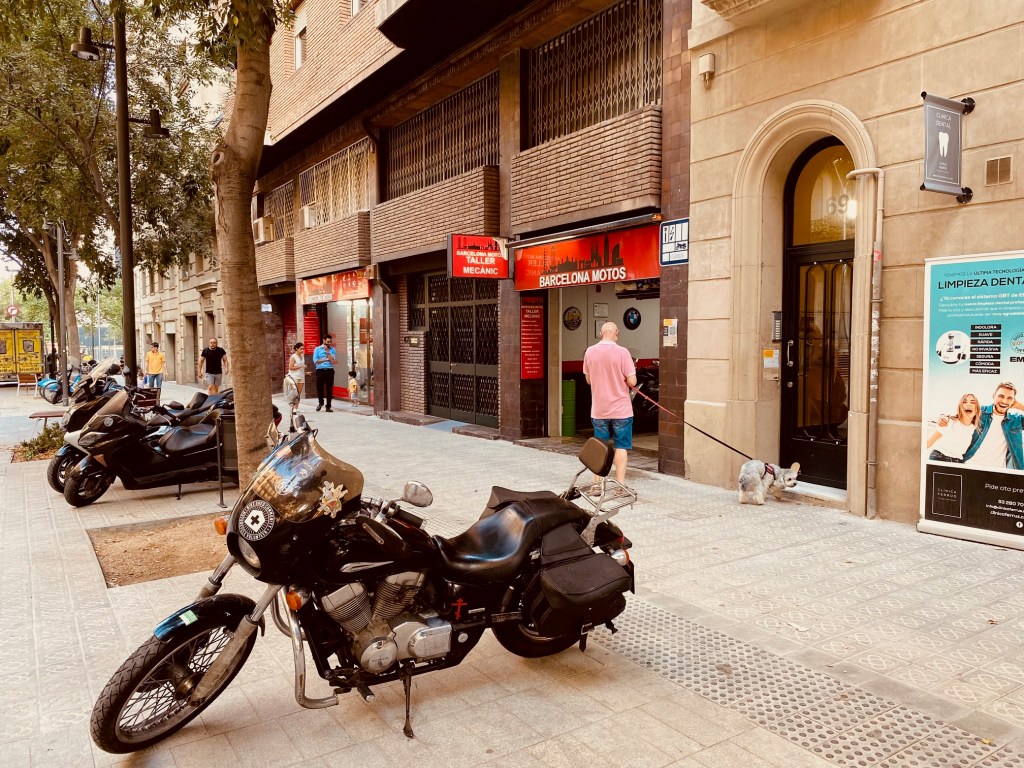
For the first couple of days, I’d booked myself into a serviced apartment type place on the Avenguda del Paral-lel at the sea end. Obviously I miss it a couple of times, but soon enough I’m parked, unpacked, in, showered, and on the balcony wearing a t shirt, flip flops and a makeshift sarong made out of the big but light cotton scarf I have with me, and drinking a nice cup of herbal tea. Barcelona has 83,000 free motorcycle parking spaces: dozens or hundreds on every street. I can see Veronica from the balcony and I’m completely comfortable parking her on the street here. It turns out that I’m in the theatre district and I’m enjoying observing the artsy bustling street life below me.
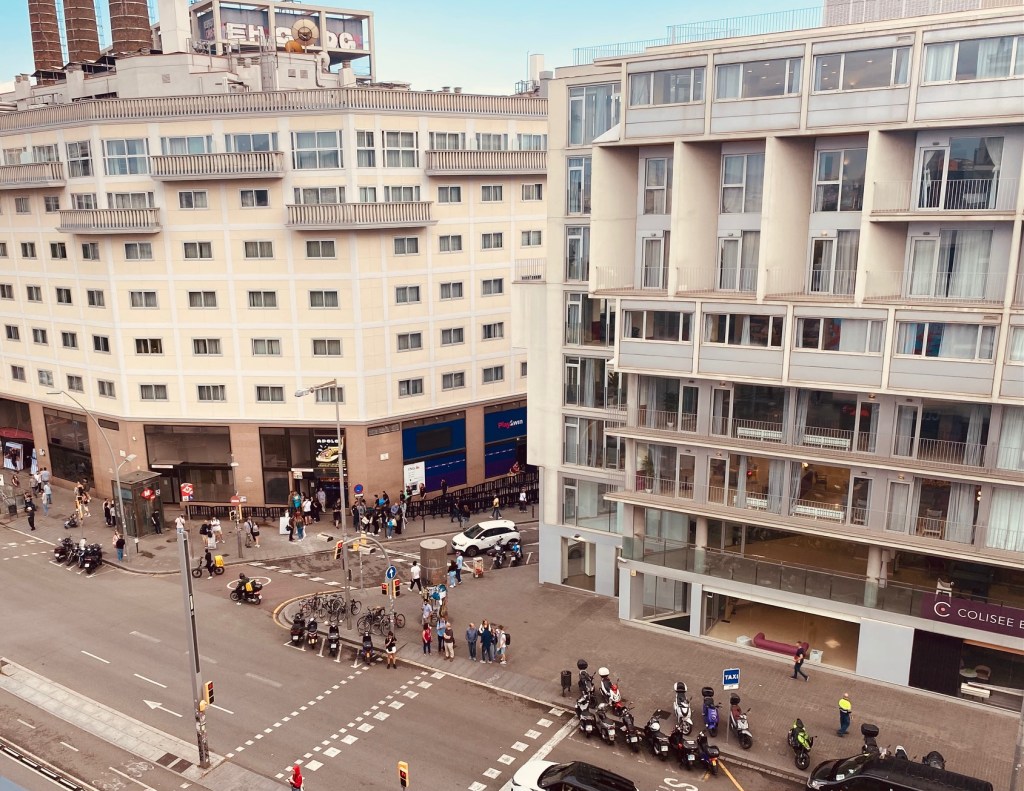
Barcelona, a vibrant and culturally rich city, sits on the northeastern coast of Spain and has a history that spans over two millennia. Its roots can be traced back to Roman times when it was founded as a colony under the name of “Barcino” in the 1st century BC. Over the centuries, Barcelona came under various influences, including Visigothic, Moorish, and Frankish rule. During the mediaeval period the city flourished as a major maritime and commercial centre, paving the way for its subsequent growth and significance. Barcelona’s history is evident in its architecture, art, and traditions, all of which make it a fascinating destination.
In addition to its broader Spanish history, Barcelona holds a unique and profound significance as the capital of Catalonia, an autonomous community within Spain with its own distinct culture, language, and history. The Catalan identity is deeply rooted in Barcelona’s heritage, shaping the city’s character and influencing its architecture, traditions, and sense of pride.
The process of the formation of a distinct Catalan identity can be traced back to the early mediaeval period when the region was part of the Carolingian Empire. During this time, the local population in the territories of present-day Catalonia started to develop a shared language, culture, and sense of regional identity. The Catalan language, closely related to Occitan and spoken alongside Spanish, holds a crucial place in the region’s cultural identity, and its use is widely promoted and protected by the local government. The historical importance of the Catalan language can be seen in various landmarks and inscriptions throughout Barcelona.
Throughout history, Catalonia has faced struggles for autonomy and self-determination, and Barcelona has been at the heart of many of these movements, and a focal point for political activism and expression of the Catalan identity. Events such as the “Diada de Catalunya” (Catalonia’s National Day) are celebrated with pride, reflecting the strong sense of regional identity that permeates the city’s social fabric. Catalan flags fly from many buildings. Following the attempted independence referendum a few years ago and the subsequent fallout, it seems that the current local authorities have reached a political truce with central government for the time being.
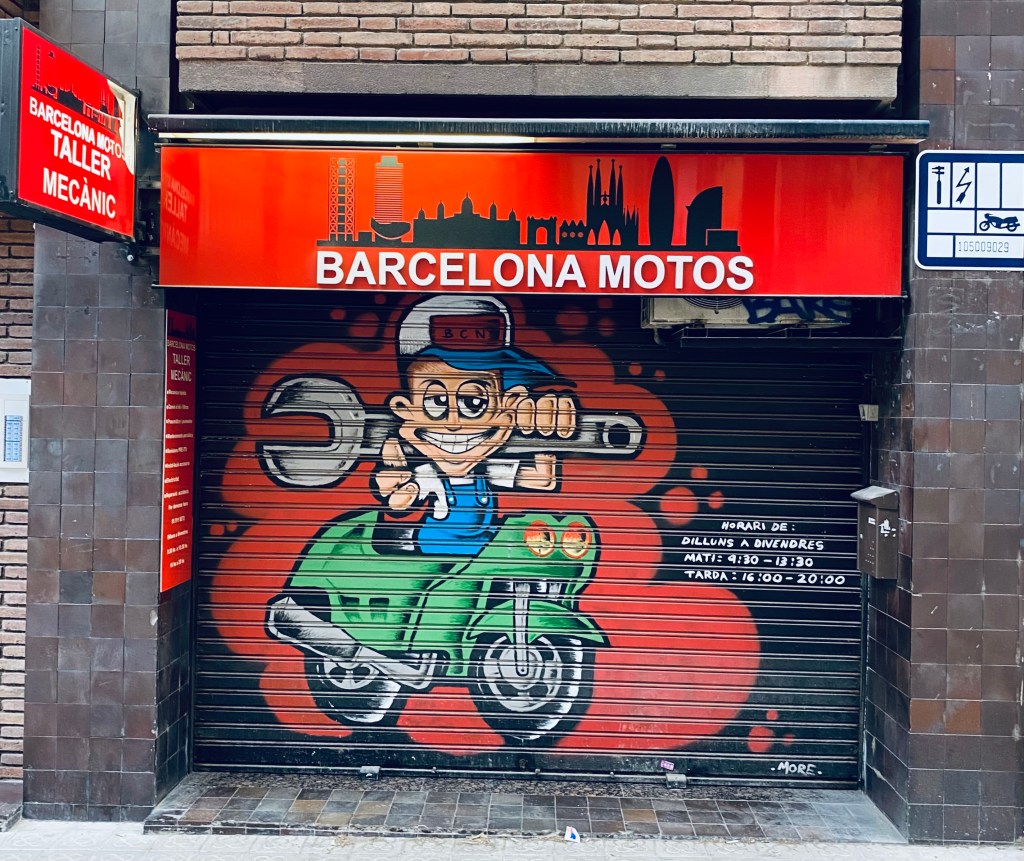
The next few days are spent riding around the city to meetings and events, blending in with Barcelona’s motorcyclists and scooterists. I ride with my jacket and visor open, and wearing summer gloves which I’d thought to pack. One simply hops off the motorbike when one gets to one’s destination, as there are motorbike parking spaces absolutely everywhere. It’s a busy bustling city but there is no congestion as there are so many motorbikes and scooters, which means there is plenty of room for the city’s millions of road users. It reminds me of a cross between Melbourne and Hanoi in that sense.
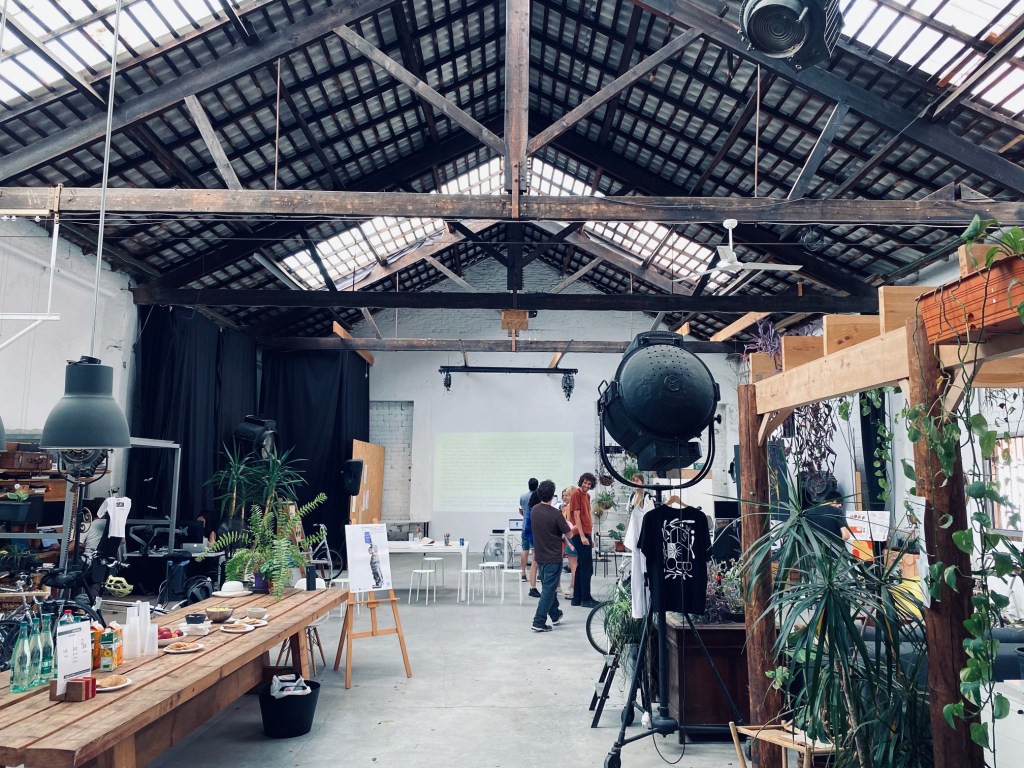
One of the places I visit is the incredible Akasha Hub; a work, event and studio space dedicated to sustainability and social innovation. There I meet with Carmen and Lorenzo and learn from them about the challenges and aspirations of Barcelona’s tech and innovation community, and later attend a fascinating event there focused on creativity and AI.
One evening I go for beers with an old friend from the UK, Dave, who tells me about an expat’s life in Barcelona, how it’s changing, local politics, how he feels about the future. It’s a deep, long evening.
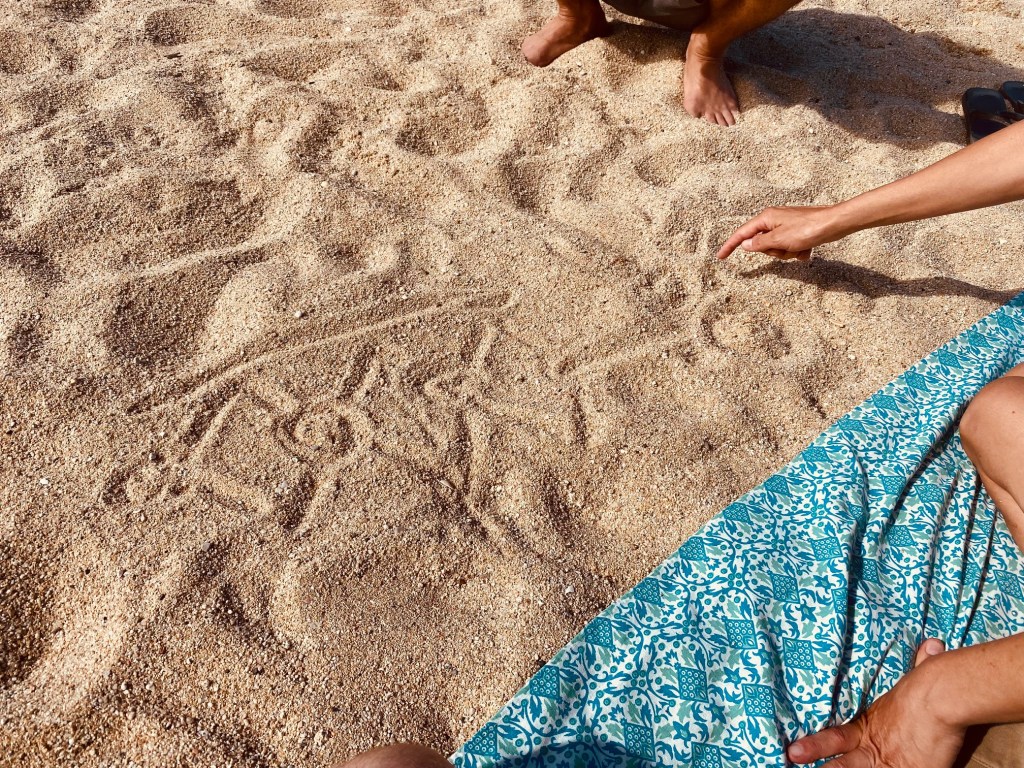
I also ride up to El Masnou, a charming beach town a few kilometres north of Barcelona to meet with Nikoline and her partner. We sit on the beach, eat delicious tabbouleh which she made, and I learn about governance models and community building from her, occasionally drawing diagrams in the sand to help illustrate the concepts we discuss.
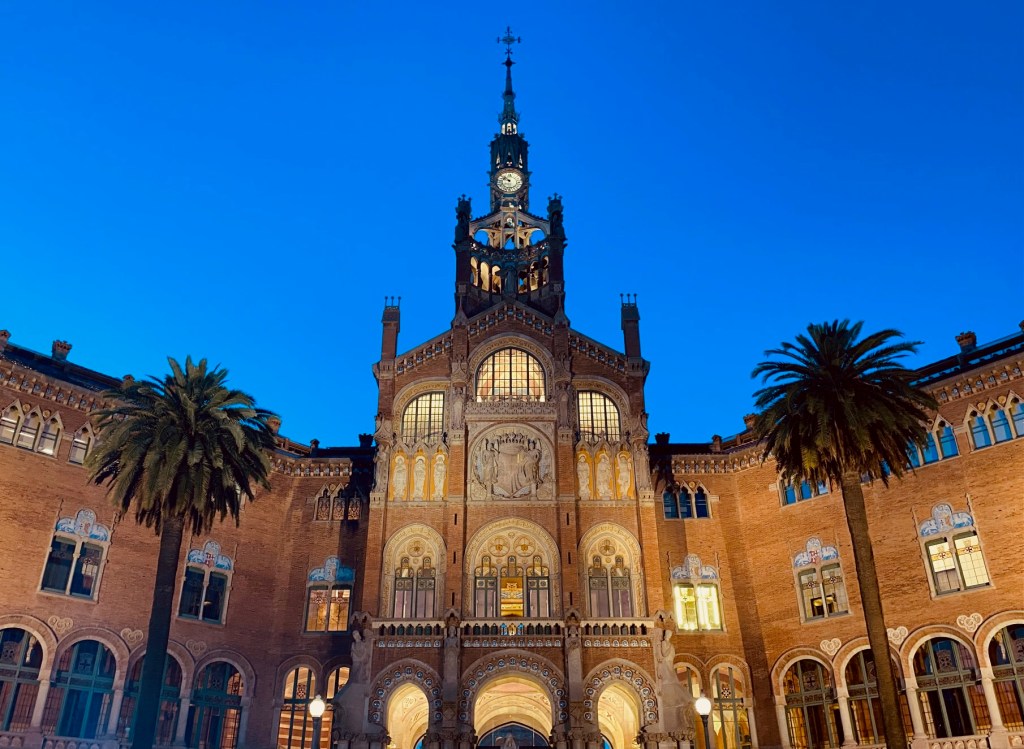
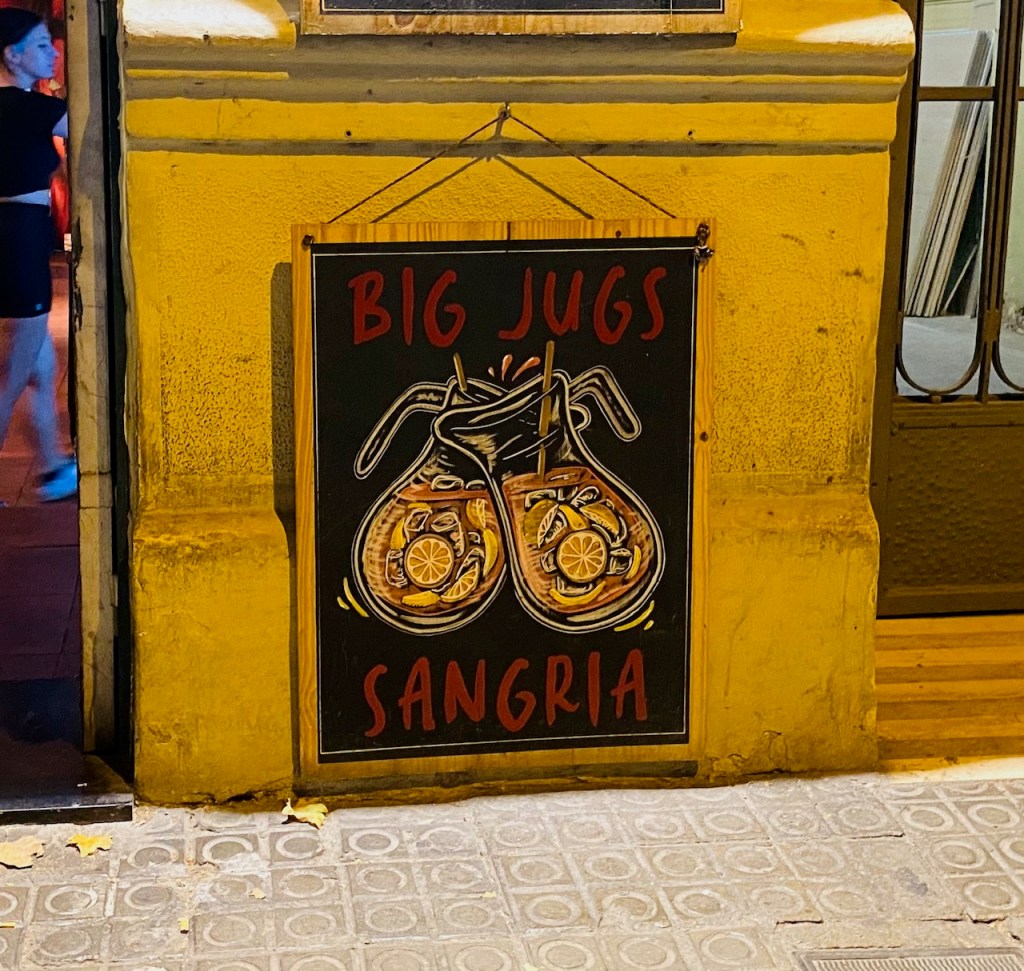
At one point I move to a room at a guest house near the gigantic St Pau hospital complex, a breathtaking architectural masterpiece designed by the renowned Catalan architect Lluís Domènech i Montaner. Built between 1901 and 1930, the complex was originally conceived as a hospital to provide medical care to the city’s inhabitants. Today, it stands as a UNESCO World Heritage Site, a testament to the modernist architectural brilliance of the early 20th century. The complex features a blend of art nouveau and neo-Gothic styles, with stunning facades adorned with intricate sculptures and vibrant mosaics. The St. Pau Hospital Complex is not only a symbol of medical progress and care but also an exceptional cultural and historical landmark. In the evenings when it’s not too hot I wander the streets near it wearing a makeshift sarong, t shirt and flip flops stopping for the occasional sangria, and mingle with St Pau’s patients who sit out on the pavements in their wheelchairs and lift their oxygen masks to smoke roll ups.
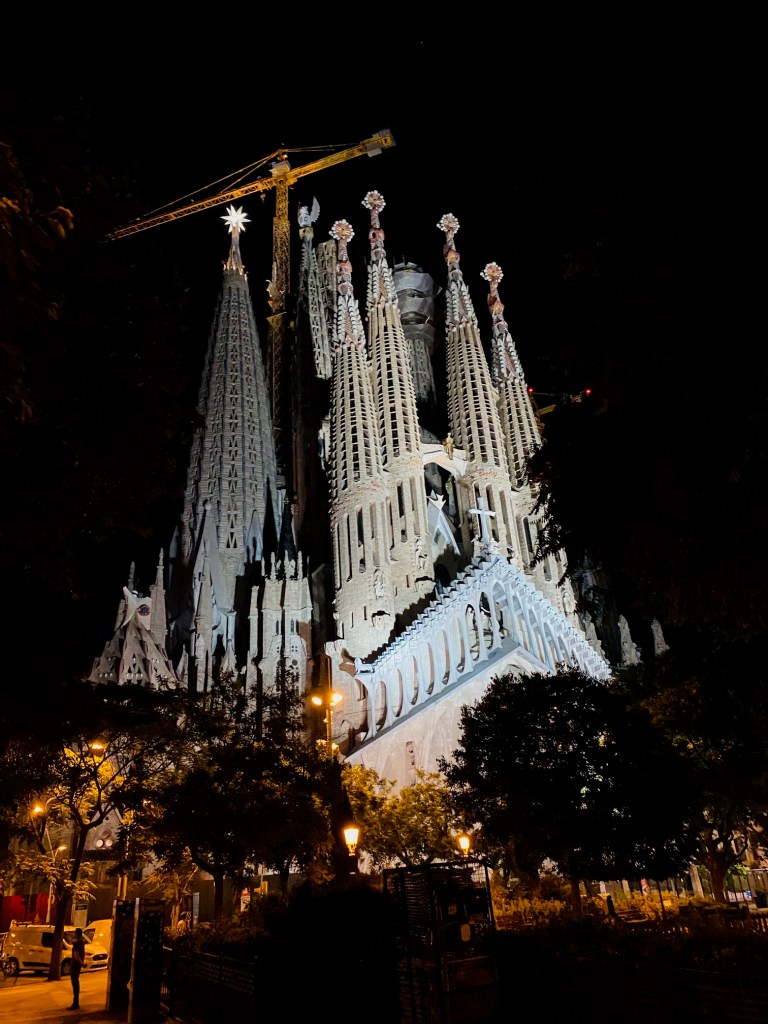
Among Barcelona’s most famous landmarks is the magnificent Sagrada Família, an architectural masterpiece designed by the visionary architect Antoni Gaudí. Construction of this awe-inspiring basilica began in 1882 and continues to this day, making it an ongoing and ever evolving artwork. The Sagrada Família combines various architectural styles, from Gothic to Art Nouveau, and features intricate facades adorned with biblical scenes, towering spires, and symbolic sculptures. Gaudí’s unique vision and the building’s remarkable design have made it a UNESCO World Heritage Site and a symbol of Barcelona’s cultural and artistic prowess. Gaudi himself was run over by a tram directly outside it whilst staring up and contemplating his partially completed creation. What has been described as its “benign madness” is disquieting and comforting all at once, and wandering around it is a somewhat disorienting experience.
Another iconic landmark defining the city’s skyline is the historic Park Güell, also designed by Antoni Gaudí. Built between 1900 and 1914 for a magnate, the park was initially intended to be a housing estate but later transformed into a public park. Its whimsical architecture, colourful mosaics, and stunning panoramic views of Barcelona make it a delightful and enchanting destination. Park Güell showcased Gaudí’s ability to blend nature and architecture seamlessly, and it remains a testament to the city’s commitment to preserving its cultural heritage.
Eventually several members of my family arrive from various parts of Europe: we’d arranged to meet up here in Barcelona. My cousin has rented a large apartment, big enough to accommodate everyone, and we go for family meals and generally spend the time catching up. The day before I leave we visit Barcelona’s bustling and lively promenade, La Rambla: a busy, vibrant and somewhat chaotic avenue that stretches from Plaça de Catalunya to the Christopher Columbus Monument at Port Vell. Lined with trees, street performers, shops, and cafés, La Rambla is home to a lively and, let’s say, dynamic atmosphere, reflecting both the city’s mayhem and its modern charm. The side streets nearby are surprisingly sedate and a relaxing drink cools everyone down.
The following morning I bring down some of my kit, leaving much of it in Barcelona as I travel to the Wheels and Waves festival in Biarritz for a few days. This time I’m carrying only a couple of changes of t shirts and underwear and a few days’ emergency supplies. Packing Veronica is quick compared to previous times when I had to put all the gear on. With my usual “toot-toot” I set off on the 400 mile run across and beyond the Pyrenees again and towards Biarritz back in France.
 Blac Ridere
One thought on “From Zaragoza to Barcelona (via Hades?)”